China Orders Closer Checks on Italian Olive Oil Imports
China’s quality watchdog, the General Administration of Quality Supervision, Inspection and Quarantine (AQSIQ), has told its inspection offices to scrutinize olive oil arriving from Italy and has asked the Italian embassy for an explanation, after Italian reports that most “Italian” oil contains oil from other countries. Italy is China’s second biggest olive oil supplier after Spain. Here is what set it off, how Spain has reacted, and why the real issue is the label rather than the oil.
What happened
According to Olive Oil Times, citing the People’s Daily and the Italian agency Adnkronos, AQSIQ has instructed its local inspection and quarantine bodies to check Italian olive oil imports carefully and has urged Chinese importers to pay closer attention to the quality of what they buy from Italy. It has also asked Italy, through its embassy, to look into the claims and to tighten control of its olive oil exports to China. The Shanghai Daily had already reported at the end of December that entry-exit inspectors were checking oil imported from Italy.
The trigger was an Italian story. In December the daily La Repubblica reported on an investigation by customs, fraud police and the finance police, with help from the farmers’ organization Coldiretti, into Italian olive oil exports, including the conduct of 13 unnamed exporters. The investigation, the paper said, had found that four out of five bottles of olive oil sold by Italy contain oil from other countries, usually Spain, Tunisia, Greece or Morocco. Coldiretti’s spokesman, Stefano Masini, called for new measures against what he called the “agromafia”.
| The numbers behind the questions | As reported |
|---|---|
| Italian olive oil exports | About 250,000 tons a year |
| Italian olive oil imports | About 470,000 tons, according to La Repubblica |
| Italy’s share of China’s olive oil imports | About 37.5 percent, second after Spain |
| Bottles found to contain foreign oil | Four out of five, according to the Italian investigation |
How Spain reacted
The Spanish response has been a mix of anger and suspicion. El País quoted Andalusia’s agriculture minister, Clara Aguilera, as saying she feared “stage-management” by Italy, with many vested interests at play and possibly a strategy to control markets, while pointing to the weakness of Spain’s fragmented production sector next to Italy’s strong olive oil lobby. Rafael Civantos of the farm union COAG said it was “common knowledge” that Italy passes off Spanish oil as its own because its figures for production, consumption and imports “don’t add up”.
The more measured voice came from Rafael Sánchez de Puerta, who chairs the olive oil working group of the EU farm lobby Copa-Cogeca. He stressed that the issue was one of labeling rather than quality. “Everyone knew” that Italy bottles and exports more oil than it produces, he said, and any fraud concerned the claimed origin of the oil, not whether it was fit to eat.
What it means for buyers
This is the part most of the coverage gets wrong. Blending oils from several countries is legal in Europe, and it is how most big brands work. Since 2009 a bottle of extra virgin or virgin oil sold in the EU has had to say where the oil comes from, and a blend has to say it is a blend of oils from the European Union, or from outside it. Our guide on how to read an olive oil label explains the wording. The offense is not mixing Spanish oil into an Italian bottle, it is printing “Italian” on the result, or suggesting it with flags and pictures of Tuscany.
- Look for the origin statement on the back, not the brand name or the flag on the front.
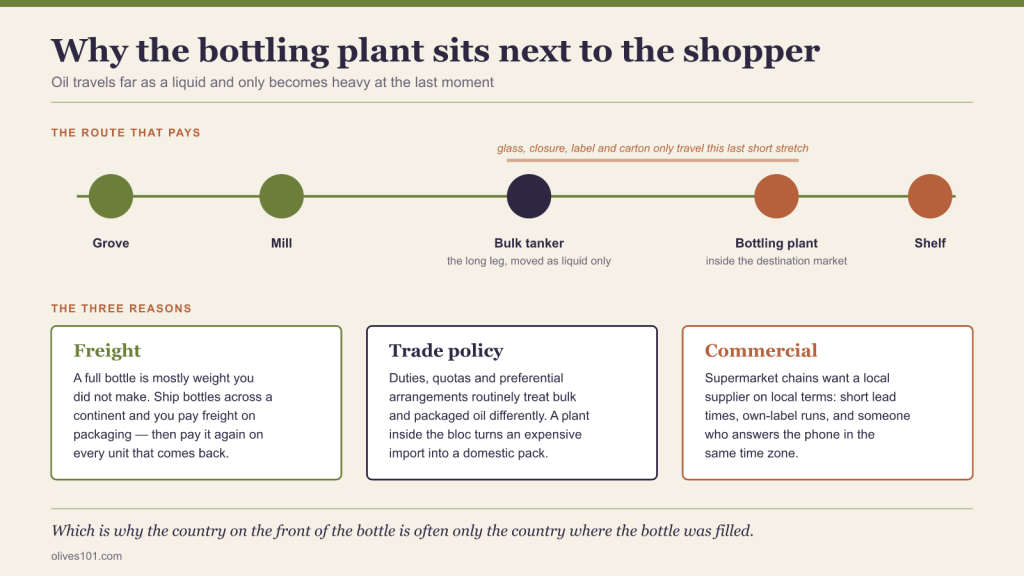
- “Bottled in Italy” or “packed in Italy” says where the bottling plant is, not where the olives grew.
- A harvest date and a single named origin are harder to fake than a slogan.
Greece complained about the same practice years ago, as we reported in “No more Italian labels on our olive oil, Greece says”, and Tom Mueller’s new book, which we reviewed in Extra Virginity, makes the trade’s blending habits its central theme.
Italy imports so much oil because it has the brands, the bottling plants and the customers, not necessarily because anybody is hiding anything. The honest question is not “is this oil Italian?” but “does the label tell me the truth about where it is from?” In export markets like China, where few shoppers read the back of a bottle, a green, white and red label does most of the selling. That is where the temptation lies.
Sources
- Olive Oil Times, “China Scrutinizes Olive Oil Imports from Italy” (January 7, 2012)
- Olive Oil Times, “Olive Oil Origin Investigations Continue” (December 30, 2011)