Two Jailed Over Sunflower Oil Sold as Extra Virgin
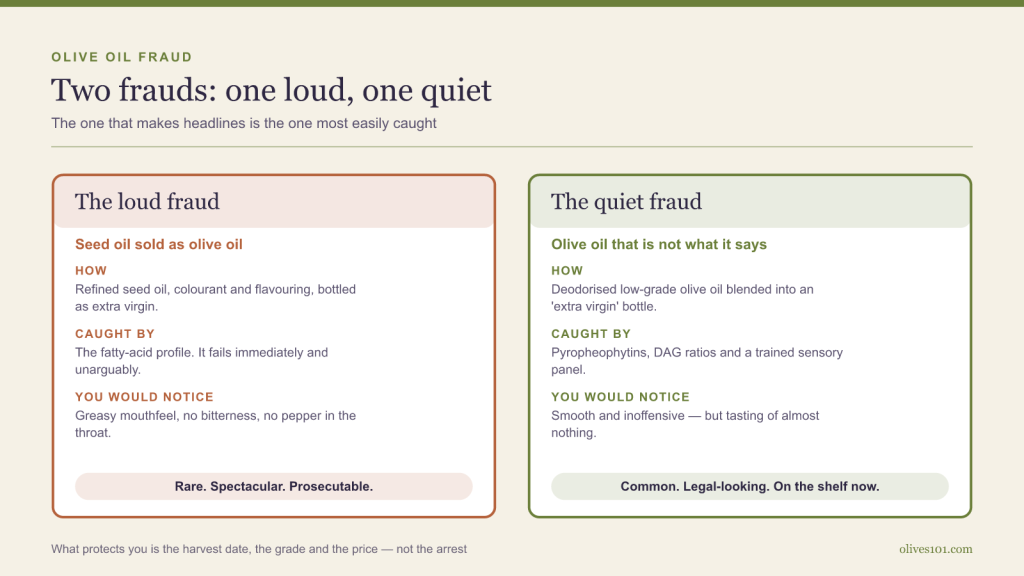
Two businessmen from Córdoba province have admitted their part in selling hundreds of thousands of liters of fake extra virgin olive oil and accepted two-year prison sentences each. A third defendant was acquitted. The oil was mostly sunflower oil, colored with an additive to look like the real thing, and it was sold in Spain in 2005 and 2006. Here is what the court heard and why this case took six years.
What they admitted
The two men, from Baena and Lucena, appeared before the second section of the Córdoba provincial court and accepted a sentence of two years each for continued fraud. Prosecutors had originally asked for nine years and fines of 8,760 euros for each defendant when the case was heard in September.
According to the prosecution, the product they packed and distributed was largely sunflower oil, with olive oil making up only a minor share, and the colorant E-141 was added so that the mixture would look like extra virgin. It went into five liter metal and plastic containers and was sold in Andalusia, Catalonia and along the Mediterranean coast.
The distribution method is the detail worth remembering. Much of it was handed out as gifts to people on organized bus trips, the sort of day excursion aimed at older customers, with the rest sold to small businesses and wine cellars. Police also shut down an online sales channel. This was not oil sold into supermarkets, where a laboratory test might have caught it, but oil moved to people who had no way to check it and no receipt to complain with.
Where the case came from
The prosecution grew out of Operation Cholesterol, a national investigation opened in 2006 after complaints about adulterated oil were confirmed by regional testing. More than ten people were arrested at the time.
Six years from complaint to sentence, and the sentence is two years for a scheme that deceived thousands of buyers. In Spain, a two-year term for a first offence generally does not mean prison. That arithmetic is exactly why fraud in this trade has been treated as a manageable business risk for decades.
| Stage | What happened |
|---|---|
| 2005 to 2006 | Mixture sold as extra virgin in 5 liter containers |
| 2006 | Operation Cholesterol, more than ten arrests |
| September 2011 | Prosecutors seek nine years for each defendant |
| December 2011 | Two accept two years each, one acquitted |
What it means for buyers
Crude adulteration of this kind is the easiest fraud to detect in a laboratory and the hardest to spot in a kitchen. A seed oil dyed green looks fine in the bottle, smells of almost nothing, and most households would simply assume they had bought a mild oil.
- Bargain five liter containers sold outside normal retail are the classic vehicle for this trade.
- Oil received as a gift or a prize on an excursion has no paper trail and no comeback.
- Real extra virgin smells of something: grass, tomato leaf, almond, artichoke. Silence in the glass is a warning.
We have covered this pattern for years: how olive oil adulteration actually works, an earlier Spanish scare, and the El País report on mislabeled extra virgin that put the subject back on the front pages last winter.
The fraud that reaches court is the stupid kind. Dyeing sunflower oil green is a crime any laboratory can prove in an afternoon. The profitable version is quieter: a cheap oil deodorised so gently that it still passes the chemistry, blended into something that carries a good label and sold at a modest discount. Nobody gets arrested for that, which is why sensory panels exist.