Sweden Asks Brussels to Cut Olive Oil Import Duties
Sweden has put a note on the table of the European Union farm ministers asking the Commission to cut the import duty on olive oil or open an extra quota, because prices have sat far above the trigger level since last September. A small procedural move, and a rare public argument between the countries that eat olive oil and the countries that grow it.
What the note says
The document is dated May 16 and circulated to the Council as 9410/06, a note from the Swedish delegation supported by the Czech Republic and the United Kingdom. Its subject line is dry: the market situation in the olive oil sector. The content is not.
The Swedes set out the position as they see it. The 2005/06 olive harvest was much lower than usual and stocks are low. Market prices for extra virgin, virgin and lampante oil are running 33 to 46 percent above the threshold level at which the Community may act to guarantee adequate supply, and they have been above that trigger since September 2005. According to the note, market statistics from earlier years show no comparable stretch of exceptionally high prices. With import duties on olive oil of 53 to 65 percent, the note argues, there is no room for market forces to work, so consumers and food manufacturers carry significantly higher costs.
The legal hook is Article 11(2) of Council Regulation (EC) No 865/2004, the common market organization for olive oil and table olives, which lets the Commission lower duties or open an autonomous import quota when prices have stayed above the threshold for more than three months. The Swedish note recalls that the Commission itself said back in September 2005 that it might propose exactly that, and urges it to get on with it. The Commission has listed the market situation as an item for ministers under any other business at their meeting next week.
Why producers will resist
Nothing irritates a southern farm ministry more than a northern one explaining the olive oil market. The producing countries have an answer ready: the shortage is a weather event, the next crop looks better, and prices are already coming off their peak, so slicing the tariff now would hand the gain to importers rather than to shoppers.
The political temperature in Spain says the rest. Madrid’s agriculture minister, Elena Espinosa, said this week that olive oil consumption has fallen 31 percent in the last three months and tied that squarely to the price rise. She accepted there had been a contraction in supply because of last year’s weather, but said increases this big are not justified by the weather alone, and warned the sector not to get rid of the goose that lays the golden eggs, because a shopper who switches to another oil may take a long time to come back.
The growers’ answer came within a day. ASAJA in Jaén called the minister’s appeal for sense in olive oil prices out of place, said she looked more worried about commerce than about agriculture, and pointed out that nobody says a word when the price at origin collapses. Whoever is right, the exchange tells you where the pressure sits in a short year: on the people who have to sell a bottle, not on the people who grew the fruit. The background to all of this is the landscape of Andalusia, where a single region’s weather decides what the rest of Europe pays.
What would actually change
Not much, and not quickly. A duty cut or an autonomous quota would let more non Community oil in at a lower landed cost, mostly from the southern and eastern Mediterranean. It would not put oil in a bottle this month, and it would not show on a label at all.
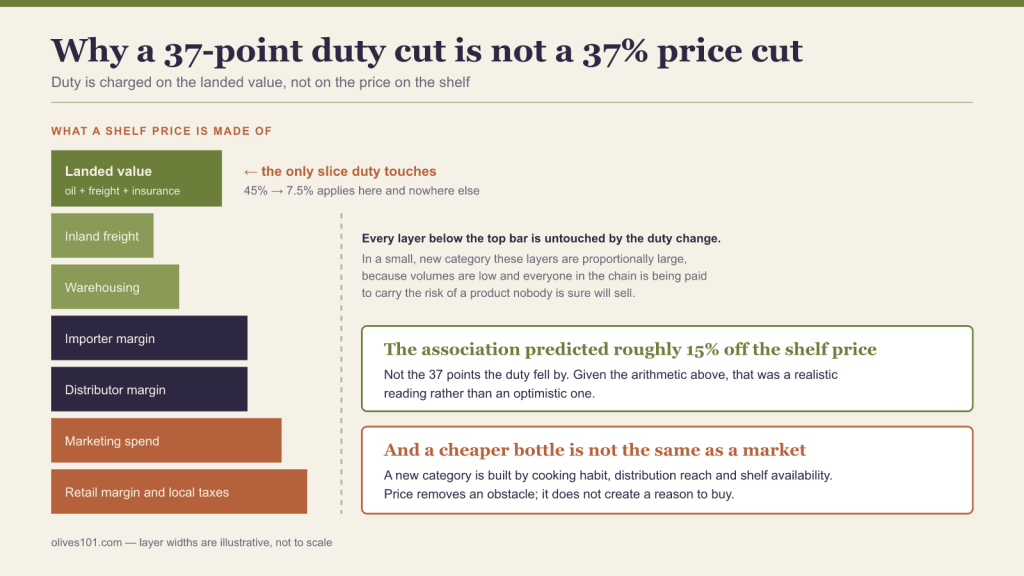
- The import duty is a large percentage, but it applies to the bulk value of oil, not to the retail price you pay.
- Between the tanker and the shelf there is refining or blending, bottling, transport, retail margin and tax.
- A cut therefore arrives softened, and arrives late, which is why import duties move shelf prices far less than people expect.
The honest summary is that both sides are arguing about a lever that is weaker than either admits. The thing that will actually settle the price of olive oil this year is the Spanish flowering, and it is already happening on the hillsides while ministers write notes.
Every time the market gets tight, the trade quietly widens what counts as acceptable oil. Lampante, the lamp grade that has to be refined before anyone can eat it, goes up in price along with everything else, and refined oil dressed up with a little virgin ends up in more bottles than usual. In a shortage, the word on the label to check is not the flag or the brand, it is the grade.
Sources
- Council of the European Union, note from the Swedish delegation, “The market situation in the olive oil sector”, 9410/06 (May 16, 2006)
- European Commission, “Preparation of Agriculture/Fisheries Council of May 2006”, MEMO/06/211 (May 19, 2006)
- Infoagro, ASAJA Jaen on the minister’s call for sense in olive oil prices (May 15, 2006)