The Olive in California: History of an Immigrant Tree
California is the only place that invented a genuinely new olive product: the soft, uniformly black, canned ripe olive that exists nowhere in the Mediterranean. Getting there took two centuries, several booms and one disaster.
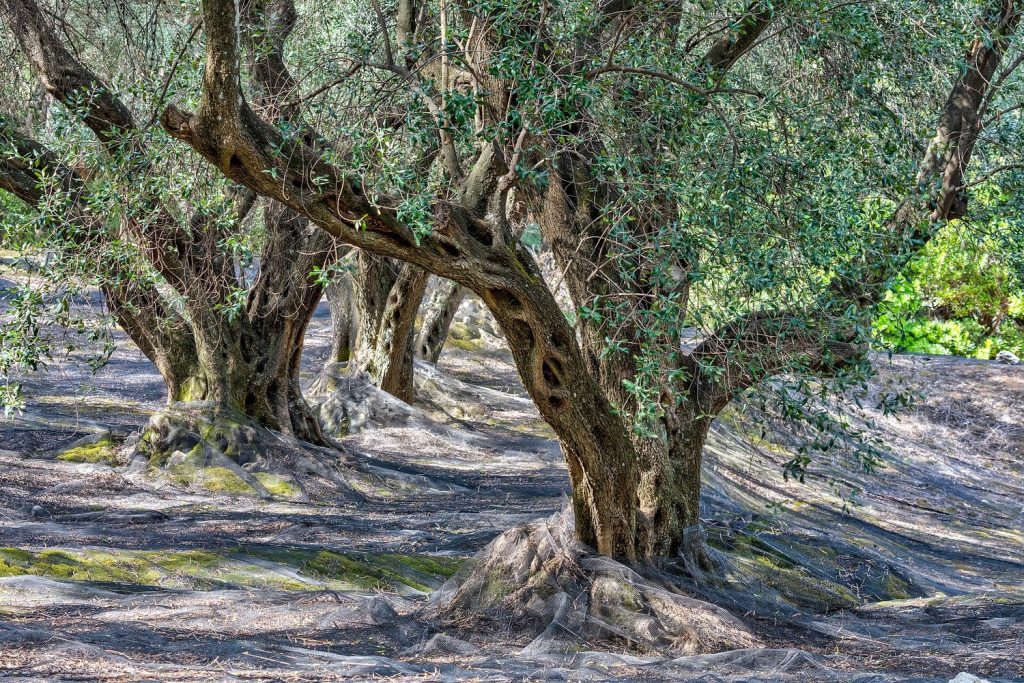
Every olive tree in the Americas is an immigrant. The species is Mediterranean and arrived with Europeans, and in California it arrived with the Franciscan mission system in the late eighteenth century, carried north from Mexico as cuttings alongside grapes and figs. The variety that came with them is still called Mission, and it is a genuinely Californian cultivar in the sense that centuries of local selection have made it distinct from any single Spanish parent.
| Late 1700s | Olives planted at the Franciscan missions, spreading north through Alta California with grapes and figs. |
|---|---|
| Mid 1800s | Missions secularised and neglected; surviving trees pass into private hands as commercial agriculture develops. |
| 1870s–1890s | A speculative olive boom. Growers plant heavily for oil, expecting to replace imports, and mostly lose money. |
| 1890s | The pivot to table olives. The canned California ripe black olive is developed and turns out to be what the market wants. |
| Early 1900s | Ripe olive canning becomes an industry in the Sacramento Valley, with Corning at its centre. |
| 1919–1920 | Fatal botulism outbreaks traced to improperly processed canned olives nearly destroy the trade. |
| 1920s onward | Strict sterilisation standards rebuild confidence; the canned ripe olive becomes an American staple. |
| 1990s–2000s | High-density hedgerow plantings of Arbequina and Arbosana revive California as a serious olive oil producer. |
The boom that failed
The late nineteenth century saw genuine olive enthusiasm in California. The climate was right, the state was busy proving it could grow anything, and imported olive oil was expensive and frequently adulterated. Growers planted with confidence.
They ran into arithmetic. Olive oil is a labour-intensive product with a low value per acre compared with the fruit crops California was simultaneously discovering it could grow spectacularly well. Against oranges, peaches and grapes, olives lost. Worse, imported oil kept arriving cheaply, and the American palate of the period had no particular attachment to it. Many of those groves were pulled out or abandoned, and the ones that survived did so mostly by finding another use for the fruit.
The American invention
That other use turned out to be an entirely new product. The California ripe olive is not a Mediterranean-style cured olive at all. The fruit is picked green or barely turning, then treated with a lye solution and repeatedly exposed to air, which oxidises it to a uniform matte black all the way through. An iron salt fixes the colour. The result is canned and heat-sterilised.
The consequence is a mild, soft, uniformly coloured olive with very little of the complexity of a naturally cured one — and that mildness was the point. It gave a country with no olive tradition an approachable, cheap, standardised product with a long shelf life, and it built an industry around the Sacramento Valley, with Corning becoming the acknowledged centre. Purists dismiss it; commercially it was one of the most successful olive products ever devised, and it is why an entire nation associates the word olive with a soft black ring on a pizza.
It also produced a near-catastrophe. Around 1919 and 1920, outbreaks of botulism traced to improperly processed canned olives killed people in several states and briefly collapsed demand. The industry’s response — rigorous, standardised heat sterilisation — became a foundation of American canning safety practice generally. It is a grim example of a food industry regulating itself into survival.
The modern oil revival
The story turned again at the end of the twentieth century. Growers imported the Spanish super-high-density model — Arbequina and Arbosana planted as dense hedgerows and harvested by straddle machines — and applied it at scale in the Central Valley. It changed the economics completely: mechanical harvesting removed the labour cost that had defeated the nineteenth century plantings, and mills minutes from the trees produced very fresh, low-acidity oil.
Alongside it came a quality-standards campaign. California producers pushed for stricter criteria than the international minimum and made freshness and grade compliance an explicit selling point against imported oil — a competitive position that only makes sense in a market where mislabelled imports had been a documented problem, as we discuss in extra virgin that isn’t.
- Mission olives are the historical Californian variety, still grown, and now more often cured than milled.
- California black ripe olives are lye-treated and oxidised, not naturally fermented — a different product from a Greek or Italian cured olive.
- Modern Californian oil is mostly Arbequina and Arbosana from hedgerow plantings.
- Freshness is the local selling point — a domestic oil reaches an American shelf far younger than an imported one.
- The state’s olive history is a story of finding a product the market wanted, twice.
California olives: common questions
When did olives arrive in California?
With the Franciscan missions in the late eighteenth century, brought north from Mexico as cuttings. The variety that came with them is still known as Mission.
What is a California ripe olive?
An olive picked green or barely turning, treated with lye and repeatedly aerated so it oxidises to a uniform black, colour-fixed, then canned and heat-sterilised. It is mild and soft, and quite different from naturally cured olives.
Why are canned black olives so mild?
Because the process is oxidation rather than fermentation. Natural curing develops complex flavours over months; the California method is fast, standardised and deliberately gentle in taste.
Why did the nineteenth century olive oil boom fail?
Because olives could not compete on returns per acre with citrus, stone fruit and grapes, labour was expensive, and cheap imported oil kept arriving. Growers pivoted to table olives instead.
What does California grow for oil today?
Mainly Arbequina and Arbosana in super-high-density hedgerows, mechanically harvested and milled close to the grove, with freshness and strict grade compliance as the selling points.
People sneer at the canned California black olive, and I understand why — next to a properly fermented Greek or French olive it tastes of very little. But it deserves respect on its own terms. It was engineered to be consistent, safe, cheap and unthreatening for a country that had never eaten olives, and it did that job so well that it defined the fruit for generations of Americans. The interesting question is not whether it is authentic. It is why nobody in the Mediterranean ever thought to make it.
Drawn from the documented history of Californian olive cultivation, the development of the ripe olive canning process and modern high-density planting practice.