Top 10 eco-friendly uses for olive oil
The household uses for olive oil circulate endlessly and get checked almost never. Here is an honest verdict on each: what genuinely works, what half-works, and the ones you should stop doing — plus the rule that makes all of them sensible.
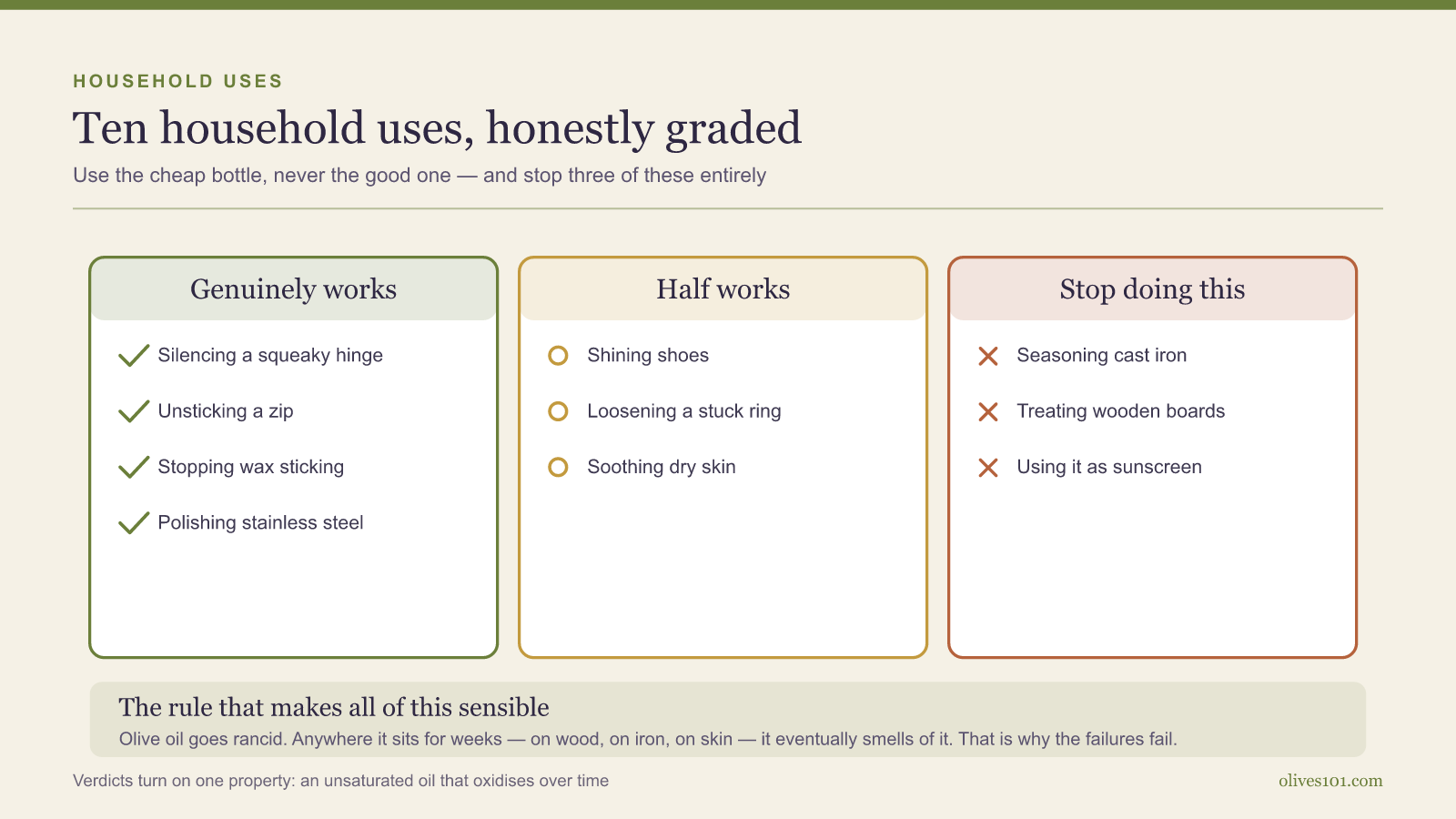
Every list of eco-friendly household uses for olive oil says roughly the same ten things, and each list has copied the last. Almost none of them ask the obvious question: does olive oil behave well in this application over weeks and months, or does it simply work for ten minutes and then cause a problem?
The answer turns on one property that the lists never mention. Olive oil is a food, and foods go off. It oxidises, polymerises into a sticky film, and eventually smells rancid — like crayons, putty or stale walnuts. Wherever a job needs a fat that will still be inert in six months, olive oil is the wrong fat. Wherever the job is done immediately, it is often excellent.
| Use | Verdict | Why | Better option |
|---|---|---|---|
| Silencing a squeaky hinge | Works | A light oil penetrates the pin and stops the noise at once | Proper machine oil if you want it to last years |
| Unsticking a zip | Works | Lubricates the teeth immediately; use a cotton bud, avoid the fabric | Candle wax or a graphite pencil, which will not stain |
| Stopping wax sticking to a candle holder | Works | A thin barrier film releases the wax cleanly | Nothing better, and this one is genuinely useful |
| Removing eye make-up | Works, with care | Dissolves oil-based make-up effectively | A dedicated cleansing oil if your skin is reactive |
| Shaving | Half-works | Provides slip, but no cushion and it clogs a razor fast | Any dedicated shave oil or soap |
| Polishing stainless steel | Skip | Leaves a film that shows fingerprints and collects dust | A damp microfibre cloth, then buff dry |
| Dusting or polishing wooden furniture | Skip | Builds a sticky layer over time and eventually turns rancid | Beeswax polish, or a proper furniture oil |
| Conditioning wooden boards and spoons | Skip | Same problem — it goes rancid and taints food | Food-safe mineral oil, which never oxidises |
| Moisturising dry skin | Doubtful | Studies have found olive oil can weaken the skin barrier | A proper emollient; sunflower seed oil has fared better in trials |
| Adding to a pet’s food for hairballs | Ask a vet | A folk remedy, dose-dependent, and not risk-free | Veterinary advice and a product designed for it |
The ones that genuinely work
Anything where the oil does its job immediately and is then wiped away or absorbed. A squeaking hinge stops squeaking the moment oil reaches the pin. A stuck zip runs freely as soon as the teeth are lubricated — apply it with a cotton bud and keep it off the fabric, because oil stains. A thin film in the base of a candle holder makes dripped wax lift out in one piece, which is one of those small tricks that is genuinely better than the alternatives.
Removing oil-based eye make-up works too, on the sound chemical principle that like dissolves like. Use a little, wipe it off, rinse. If your skin reacts, stop — see below.
The ones to stop doing
Wood. This is the big one, and the lists get it consistently wrong. Olive oil on a cutting board, a wooden spoon or a table looks wonderful for a fortnight. Then it oxidises into a tacky layer that attracts dust, and eventually it goes rancid — and rancid oil on a board that touches food is unpleasant and hard to remove. The standard advice for kitchen wood is food-grade mineral oil precisely because it is inert and never oxidises. For furniture, use a wax polish.
Stainless steel. It shines briefly and then holds every fingerprint and every speck of dust. A damp microfibre cloth and a dry buff does the job better and leaves nothing behind.
Skin, as a default moisturiser. This deserves care, because the advice is so widespread and so confidently given. Controlled studies applying olive oil to adult skin have found it can damage the skin barrier rather than support it, and dermatology guidance in several countries now discourages it for infant skincare, where it was once routine. Sunflower seed oil has performed considerably better in the same comparisons. This does not mean olive oil will harm everyone who uses it — many people use it happily — but it does mean it should not be the automatic recommendation, particularly for babies or for anyone with eczema. This is general information, not medical advice.
Pets. A dab of fat for hairballs is a very old kitchen remedy, but dosing an animal is not a household tip. Cats can react badly to sudden changes in fat intake, and there are formulated products and a professional whose entire job this is. Ask them.
The rule that makes all of this sensible
Never use your good oil. If you are lubricating a hinge, releasing candle wax or freeing a zip, the oil is a solvent and a lubricant, and the phenols, aromas and harvest date you paid for are entirely wasted on the job. Keep a cheap, refined bottle — literally the cheapest in the shop — under the sink for non-food purposes, and keep your extra virgin for the plate.
And check it before you use it anywhere. Rancid oil smells of crayons, putty or old walnuts. If your household bottle has been open since last winter, it is fine for the hinge and no longer fine for a salad. Understanding what you are actually buying makes it much easier to decide which bottle deserves which job.
Practical takeaways
- Two bottles. A cheap refined one for household jobs, a good extra virgin for food. Never confuse them.
- Nothing porous and permanent. Wood, cork and unsealed stone will eventually smell of rancid oil.
- Use mineral oil for kitchen wood. It is inert, food-safe and does not oxidise.
- Test on a hidden patch before applying oil to any finished surface or fabric — it stains.
- Skip the skin claims unless it already works for you, and avoid it on babies.
- Ask a vet before feeding oil to an animal, however small the amount.
- Smell the bottle first. Crayon or putty means rancid — fine for hinges, not for dinner.
This is general information, not medical advice.
Household uses for olive oil: common questions
Can I use olive oil on wooden chopping boards?
Better not. It oxidises into a sticky film and eventually turns rancid, which taints the board and is hard to remove. Food-grade mineral oil is the standard choice because it is inert and never goes off.
Is olive oil good for your skin?
Less clearly than the lists suggest. Controlled studies have found that applying olive oil can weaken the skin barrier in adults, and dermatology guidance in several countries now discourages it for infant skincare. Sunflower seed oil performed better in the same research. This is general information, not medical advice.
Does olive oil work as a lubricant?
For immediate jobs, yes — a squeaky hinge or a stuck zip will free up straight away. It is not a long-term lubricant, because it thickens and eventually gums up, so use proper machine oil where durability matters.
Should I polish stainless steel with olive oil?
No. It shines for a moment then leaves a film that shows every fingerprint and traps dust. A damp microfibre cloth followed by a dry buff gives a better result and leaves nothing behind.
Can I give my cat olive oil for hairballs?
Ask a vet. It is an old kitchen remedy and the dose matters, and sudden changes in dietary fat can upset an animal. There are formulated products designed for the purpose and a professional who can advise on your specific pet.
What always strikes me about these lists is that they treat olive oil as a chemical rather than a food. It is a fresh fruit juice with a shelf life, and every use that leaves it sitting on a surface for months ends the same way : sticky, then rancid. So my rule is simple and it has never let me down. If the oil will be wiped off or absorbed within the hour, use it and enjoy the smugness. If it has to stay put — on wood, on leather, on anything porous — reach for something that was designed not to go off. And whatever you do, do not use the bottle you bought for the salad.
Skin-barrier findings from published dermatology research comparing olive and sunflower seed oil; wood-care practice from standard food-safe finishing guidance.