India’s olive experiment take off in Rajasthan this week
Olive trees do not grow in India. That was the settled view when Rajasthan planted its first trial groves near Jaipur with Israeli varieties and drip irrigation. The trees proved the view wrong. Then the harder questions arrived.
The premise sounded implausible when it was announced and it is worth restating plainly: a state better known for sand dunes and forty-five degree summers decided to find out whether it could grow a Mediterranean tree. The vehicle was a joint venture between the state agriculture marketing board, a micro-irrigation company and an Israeli olive firm, and the method was proper agronomy rather than optimism — import a spread of varieties, plant them across contrasting districts, and see which ones survive and fruit. Something over a hundred thousand saplings of seven varieties, among them Barnea, Arbequina, Koroneiki, Picual, Frantoio and Picholine, went into a few hundred hectares of state land, backed by a nursery at Bassi near Jaipur and subsidies on saplings, fertiliser and drip systems.
Why anyone thought a desert could work
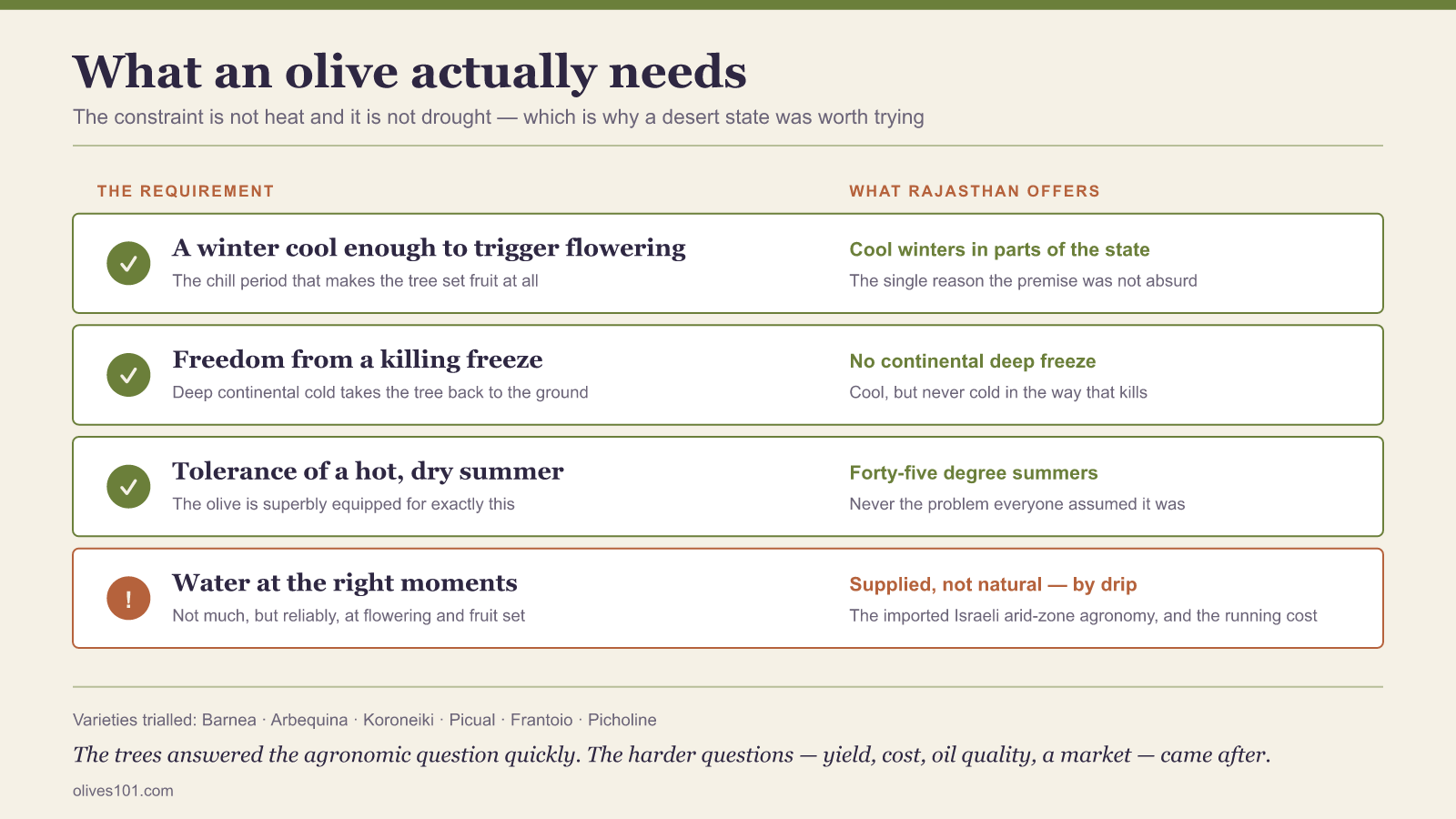
Because the constraint on olives is not heat, and it is not even drought. The olive is superbly equipped for dry summers. Its real requirements are a winter cool enough to trigger flowering — the chill period that makes the tree set fruit — and freedom from the deep freezes that kill it outright. Parts of Rajasthan have exactly that combination: hot dry summers the tree tolerates well, and cool winters without the killing cold of a continental climate.
The second reason was Israeli. Israel had spent decades building olive agronomy for arid conditions, including varieties selected for hot climates and irrigation practice designed for scarce water. Barnea, an Israeli cultivar bred for exactly these conditions, was the obvious candidate, and drip irrigation — the technology the Indian partner brought — was the thing that made the whole idea arithmetically possible in the first place.
What actually happened
It worked, in the narrow sense. The trees survived, they flowered and they fruited, and laboratory testing found oil content in a range that was respectable if a little below what leading producing countries achieve. Rajasthan went on to build an extraction unit with Italian equipment, establish a refinery at Bikaner, expand plantings, and in 2016 launch what was billed as India’s first domestically produced olive oil brand.
And at the same time, in the terms that matter commercially, it stayed tiny. Annual olive production has been measured in the low hundreds of tonnes — against an Indian market supplied over ninety-five per cent by imports, chiefly from Spain and Italy. The gap between those two facts is the whole lesson of the project, and it has nothing to do with whether the trees can grow.
What frontier olive projects always underestimate
Not the tree. In my experience the horticulture is the part that goes best, because it is the part that gets the attention, the trial data and the visiting experts. What gets underestimated is everything downstream. A mill has to be close enough that fruit reaches it within a day or two, and it has to be busy enough to justify its own existence, which is hard when the crop is small and scattered. Someone has to be able to grade the oil credibly. Growers need years of extension support to learn pruning, irrigation timing and pest control that no one in the district has ever done before. And a domestic market has to be persuaded to buy a local version of a product it has only ever known as an expensive import — usually while the imported version is cheaper.
Add the biology that no amount of planning removes: olives take years to reach real bearing, they alternate heavily between a good year and a poor one, and any project judged on the numbers from a single season will be judged wrongly.
| Project vehicle | A joint venture of the state agriculture marketing board, a micro-irrigation firm and an Israeli olive company |
|---|---|
| First plantings | Around 2007–08, on state land near Jaipur and in contrasting districts |
| Varieties | Barnea, Arbequina, Koroneiki, Picual, Frantoio, Picholine and Cortina, imported from Israel |
| Enabling technology | Drip irrigation, essential to viability in a low-rainfall state |
| Nursery | Bassi, near Jaipur, established to raise plants at scale |
| Processing | Italian extraction equipment, with a refinery established at Bikaner |
| Branding | A state-backed Indian olive oil brand launched in 2016 |
| Scale reality | Output in the low hundreds of tonnes of fruit a season, against an import-dominated market |
Takeaways for anyone planting on a frontier
- Chill, not heat, is the binding constraint. Check winter cool hours before you check summer maxima.
- Trial several varieties, deliberately. Rajasthan’s decision to plant seven and compare them was the single best call in the project.
- Site the mill before you plant the last block. Distance to milling caps the quality of everything you grow.
- Budget for extension, not just saplings. Skills are scarcer than trees in a region with no olive tradition.
- Judge on a decade. Alternate bearing and slow maturity make single-season verdicts meaningless.
Olives in Rajasthan: common questions
Do olive trees grow in India?
Yes. Rajasthan’s trials proved that suitable varieties can survive, flower and fruit there, with drip irrigation and appropriate variety selection.
Which varieties were used?
Seven imported from Israel, including Barnea, Arbequina, Koroneiki, Picual, Frantoio, Picholine and Cortina. Barnea was bred for hot, arid conditions.
Does India produce its own olive oil now?
Yes, in small quantities, with a state-backed brand launched in 2016. Volumes remain very small relative to imports, which supply the overwhelming majority of Indian consumption.
Why does a desert state suit olives at all?
Because olives tolerate hot dry summers well. The real requirements are a cool winter period to trigger flowering and the absence of severe freezes, which parts of Rajasthan provide.
What limits the project’s growth?
Not the trees. Milling capacity close to the fruit, grading skills, extension support, alternate bearing and competition from cheaper imports are the practical limits.
I have watched a number of these frontier projects and I have stopped judging them by whether the trees fruit — they usually do. The question I ask now is what the third harvest looked like, because that is when the novelty has worn off, the officials have moved on, and the grower is alone with a crop, a distance to the nearest mill and a price. Rajasthan deserves credit for doing the boring part: a nursery, a mill, a refinery, a brand. Most projects never get past the photograph of the first planting. Whether it ever competes with Spanish oil is beside the point. It proved the tree grows, and it built the machinery to find out what happens next.
Drawn from published accounts of the Rajasthan olive cultivation programme, its variety trials and processing investments, and reporting on India’s olive oil market and import dependence.