Pakistan and Greece to sign MoU for olive oil production
Cooperation agreements between an established olive nation and an aspiring one look like diplomacy and are really about germplasm, grafting and grading. Decades on from the first such deals, Pakistan took a permanent seat at the International Olive Council.
Memoranda of understanding between countries make thin news. Two agriculture ministries agree to cooperate, a document is signed, and very little appears to happen. But in olive growing these agreements matter more than they look, because what an emerging olive country actually needs from an established one is not goodwill. It is plant material, nursery technique, milling know-how and — eventually — recognition of its standards. Pakistan is a good case study in all four.
The wild olive advantage
Pakistan’s real asset is not new planting. It is an estimated eight million or more wild olive trees — Olea ferruginea, known locally as kahu — already growing across the northern hills and the Balochistan highlands. These are established trees with mature root systems that have survived local conditions for decades, and their fruit is small, hard and of little commercial use.
The technique that unlocks them is grafting. Take a wild tree and graft scions of a productive cultivar onto it, and you get an orchard tree bearing usable fruit years earlier than a newly planted sapling — because it already has the roots. Millions of wild trees have been grafted this way, alongside millions of new plants. It is one of the most efficient routes into olive growing available to any country, and it requires almost exactly the kind of technical cooperation that these agreements exist to provide.
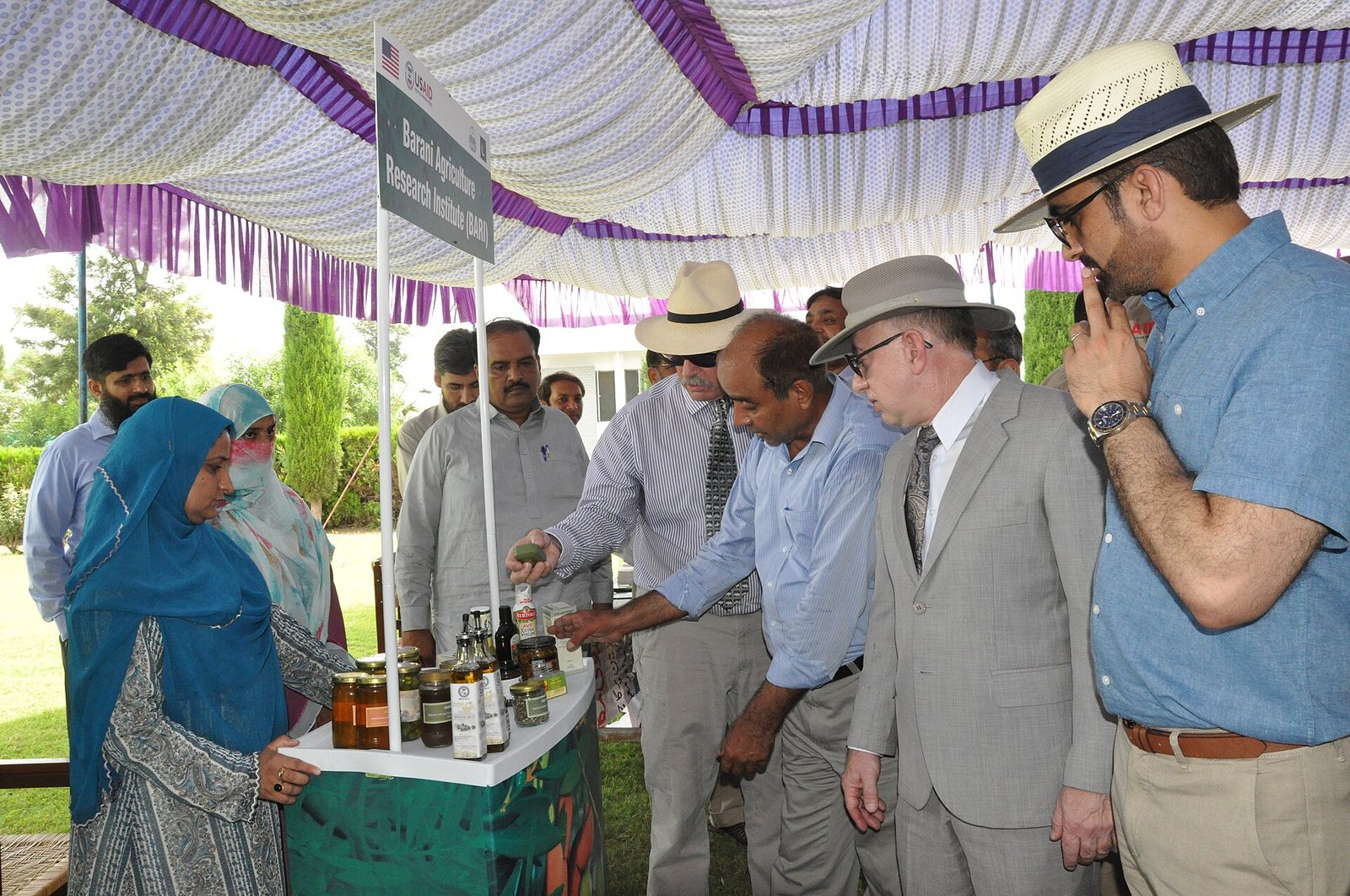
The other half of the plant-material problem is cultivars. The Barani Agricultural Research Institute at Chakwal developed local selections — BARI Zaitoon 1 and 2 — from imported germplasm, which is the unglamorous, decade-long work of finding out which Mediterranean varieties actually perform in a Pakistani summer. That is what a cooperation agreement is for.
| Wild olive stock | Estimated over 8 million trees of Olea ferruginea (kahu) |
|---|---|
| Main growing belt | The Pothohar plateau — Chakwal, Attock, Rawalpindi, Khushab |
| Other areas | Khyber Pakhtunkhwa and the Balochistan highlands |
| Key institution | Barani Agricultural Research Institute, Chakwal |
| Local selections | BARI Zaitoon 1 and 2, developed from imported germplasm |
| Method | Grafting productive cultivars onto established wild trees, plus new planting |
| Scale | Reported at over seven million trees across roughly 55,700 acres |
| International status | Acceded to the International Olive Council and took a permanent seat in 2026 |
Trees are the easy part
Here is the point that gets lost in the tree-planting announcements, and it applies to every emerging olive country, not just this one. Growing olives is the straightforward bit. What is hard is everything between the branch and the bottle.
You need mills within a short drive of the groves, because quality falls with every hour between picking and crushing. You need enough milling capacity to handle a whole district’s fruit inside a narrow ripening window. You need cool, dark, inert storage — steel tanks, not drums in a warehouse. You need a laboratory that can run the chemical tests that define the grades, and a trained sensory panel, because in international standards extra virgin is partly a taste judgement made by qualified people. And you need all of it before a single bottle can be sold abroad as certified extra virgin.
That is why a country can plant millions of trees and still find its oil trading as an anonymous commodity. The trees are a decade’s work; the quality infrastructure is a generation’s.
Why an olive council seat is the real milestone
Which brings us to the least glamorous and most consequential development. In 2026 Pakistan acceded to the International Olive Council and took a permanent seat, with a reported seven million-plus trees across some 55,700 acres.
Membership of that body is not a prize. It is an alignment: adopting the international trade standard for olive oils, the analytical methods that go with it, and the sensory assessment framework. It is the difference between saying an oil is extra virgin and being able to demonstrate it in a way that a European or Gulf importer will accept without argument.
For an exporting country that is the whole game. Grafting a wild tree gets you fruit. Standards and methods get you a price. Everything else — the ministerial signings, the tree-tsunami headlines, the target of tens of millions of trees — is either the beginning of that process or a consequence of it.
What to watch, and what to expect in the bottle
- Watch mills, not tree counts. Milling capacity within an hour of the groves is the best single predictor of quality in a new region.
- Grafted wild trees crop sooner than new plantings — expect volumes to arrive faster than the planting figures suggest.
- Expect variability early on. New regions take years to settle on harvest timing and varietal choices that suit their climate.
- Standards adoption is the export signal. Council membership and accredited testing matter more than any planting target.
- If you find a bottle, buy it young and judge it on bitterness and pungency, as you would any other oil.
- Do not expect a bargain. Small emerging-origin production is rarely cheap, and should not be.
Pakistan and olive growing: common questions
Does Pakistan grow olives?
Yes, and increasingly seriously. The Pothohar plateau around Chakwal is the heartland, with further planting in Khyber Pakhtunkhwa and the Balochistan highlands, and reported plantings of over seven million trees across roughly 55,700 acres.
What is the wild olive advantage?
Pakistan has an estimated eight million or more wild olive trees with established root systems. Grafting productive cultivars onto them produces usable fruit far sooner than planting new saplings, because the tree already has decades of root growth behind it.
Why do countries sign olive cooperation agreements?
To transfer what cannot be bought off a shelf: plant material and cultivar trials, nursery and grafting technique, milling and storage know-how, and eventually help with laboratory and sensory assessment capacity.
What does International Olive Council membership mean?
Alignment with the international trade standard for olive oils, its analytical methods and its sensory framework. In practice it is what allows a country’s oil to be sold abroad as certified extra virgin without dispute.
Is the hard part growing the trees?
No. Olives grow readily in the right climate. The difficult and expensive part is everything after the harvest — enough mills close enough to the groves, proper storage, laboratories and trained tasting panels.
Every few years a country announces that it will plant tens of millions of olive trees and become self-sufficient in edible oil. I have watched several of these announcements, and the trees are almost never the problem. What separates the countries that end up exporting from the ones that end up with a commodity crop is dull, expensive and rarely announced : mills close to the groves, steel tanks instead of drums, a laboratory, and a trained panel of tasters. Pakistan taking its seat at the olive council is worth more to its growers than any planting target, because it is the moment the world agrees to measure your oil by the same ruler as everyone else’s.
Wild olive stock, growing regions, institutional detail and council accession from Pakistani agricultural research publications and national reporting.