California: Big olive mill in works
When California built industrial-scale olive mills in the Sacramento Valley, it did not simply scale up an old craft. It imported an entirely different way of growing olives — hedgerows, machines, and a very short list of varieties.
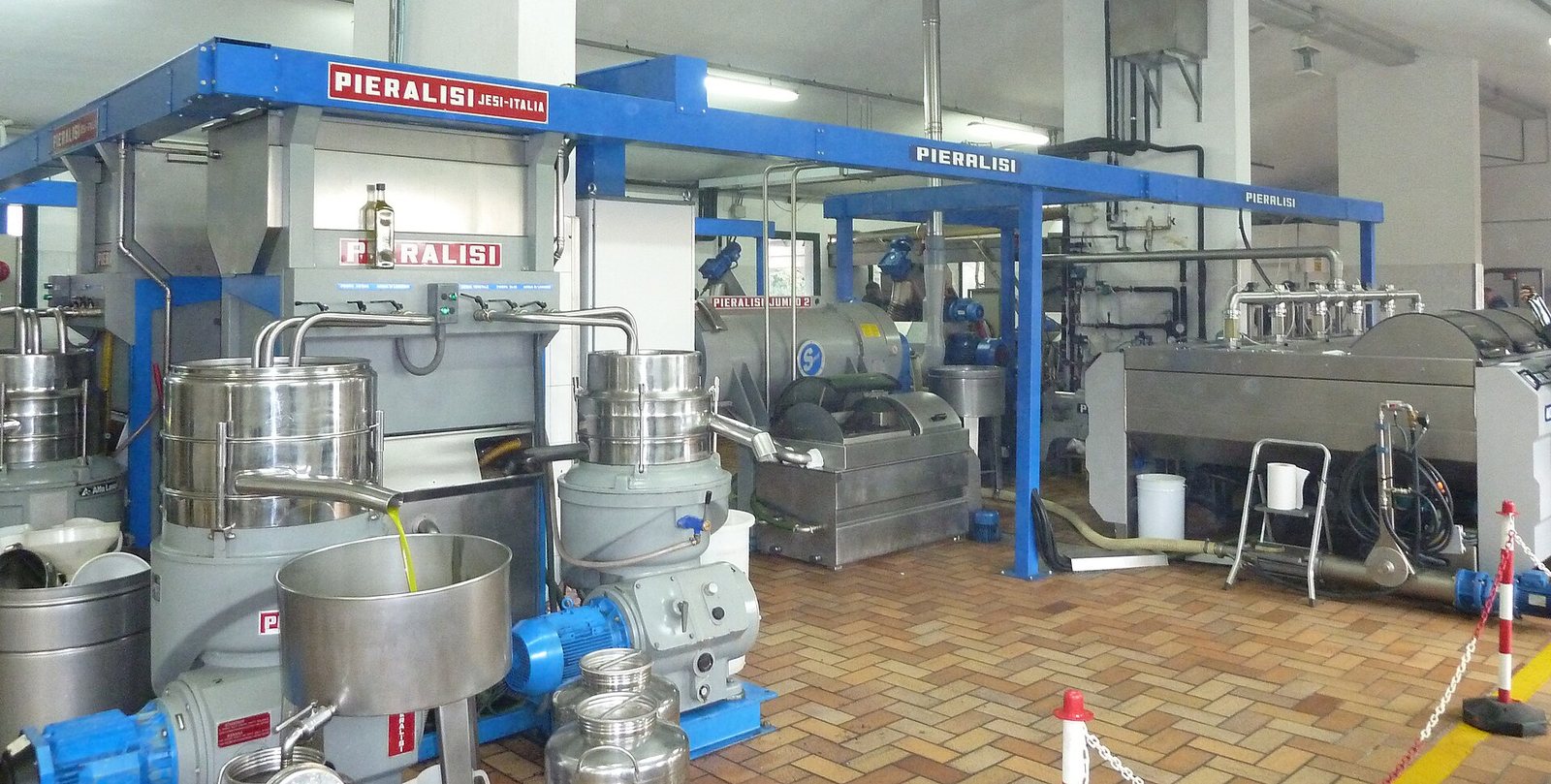
The California olive oil industry as it now exists is barely a generation old, and it was built backwards. Instead of a landscape of old trees looking for a mill, the state got mills designed first, at a scale nobody in the Mediterranean would have contemplated, and then planted the orchards to feed them. Understanding that inversion explains almost everything about Californian oil — its freshness, its consistency, its low price for the quality, and its narrowness.
What a big mill actually does
A modern mill is a continuous line, not a batch process. Fruit arrives, is de-leafed and washed, and goes into a hammer or disc crusher that reduces it to paste. The paste is then malaxed — slowly churned, usually for twenty to forty-five minutes, at a controlled temperature — which lets microscopic oil droplets coalesce into larger ones that a centrifuge can separate. Then a horizontal decanter spins the paste into oil, water and solids, and a vertical centrifuge polishes the oil.
Two numbers dominate quality here, and neither is about size. The first is the time between picking and crushing: every hour of delay lets enzymes and fermentation start work, and the free acidity climbs. The second is malaxation temperature — go above roughly 27 °C and you get more oil out, but you drive off the volatile aromas and lose phenols, which is exactly why the phrase ‘cold extracted’ has a legal definition.
The advantage of a large mill next to its own orchards is simply that both numbers are easy to control. Fruit picked in the morning can be paste by lunchtime. That, far more than any romance about stone wheels, is why the oil is good.
The hedgerow that made it possible
None of it works without a completely different orchard. Traditional groves hold something like a hundred to a hundred and fifty trees per acre, widely spaced, often on hillsides, harvested by shaker or by hand. Super-high-density planting puts five to seven hundred trees per acre in narrow, continuous hedgerows, trained so that a machine like a grape harvester can straddle the row and comb the fruit off as it drives.
The consequences run right through the product. Harvest cost collapses, which is what makes the oil affordable. Fruit reaches the mill in a steady stream, which is what makes it fresh. But the trees must be small, upright, early-bearing and tolerant of crowding — and remarkably few olive varieties are. In practice the whole system rests on three: Arbequina and Arbosana from Spain, and Koroneiki from Greece, with Arbequina doing most of the work.
| Traditional grove | Super-high-density hedgerow | |
|---|---|---|
| Trees per acre | Roughly 100–150 | Roughly 570–670 |
| First meaningful crop | 5–8 years | 3–4 years |
| Harvest | Trunk shaker, rakes, or by hand | Over-the-row machine, continuous |
| Varieties possible | Almost any | A short list — small, upright, early-bearing |
| Time to the mill | Often a day or more | Frequently the same day |
| Productive life | Decades to centuries | Commonly replanted after 15–25 years |
| Flavour outcome | Varied, site-specific, uneven | Consistent, clean, delicate — and similar year to year |
What you gain and what you give up
Let me be plain, because the argument usually gets fought on tribal lines. What California’s system gives you is genuinely valuable: fresh oil, made from healthy fruit, milled within hours, at a price a household can afford, with a harvest date printed on the bottle. Judged on defects — the rancid, fusty, winey faults that ruin so much cheap Mediterranean oil — it is among the cleanest oil in the world.
What you give up is variety, in both senses. An industry standing on three cultivars produces a narrow band of flavours: soft, buttery, faintly grassy, mildly bitter. Arbequina in particular gives a delicate, low-pungency oil with a shorter useful life than a robust Picual or Coratina — it is lovely young and fades faster. And there is no equivalent of a thousand-year-old Puglian tree in a hedgerow that gets pulled out and replanted within a working lifetime.
So: buy Californian oil for freshness and cleanliness, and drink it young. Buy Mediterranean oil, from a named region and a named mill, when you want the oil to taste of somewhere in particular. They are answers to different questions.
Buying Californian oil well
- Drink it young. The delicate hedgerow varieties are at their best within a year of harvest and fade noticeably after that.
- Look for the harvest date, which Californian producers print far more readily than most.
- Watch for the state seal. The California Olive Oil Council’s certification means a panel has actually tasted it.
- Expect gentleness. If you want a peppery, throat-catching oil, this is not usually the aisle.
- Do not pay Tuscan prices for it — the point of the system is that good oil got cheaper.
- Check it is Californian, not merely bottled there. See what ‘extra virgin’ really means.
Big mills and hedgerow olives: common questions
What is super-high-density olive growing?
Planting olives in narrow hedgerows at roughly 570 to 670 trees per acre, instead of the 100 to 150 of a traditional grove, so that a machine can straddle the row and harvest continuously. It requires small, upright, early-bearing varieties.
Which varieties are used?
Overwhelmingly Arbequina, with Arbosana and Koroneiki. Very few cultivars tolerate the crowding and the mechanical harvest, which is why the flavour range of hedgerow oil is narrow.
Does industrial milling make worse oil?
No — often the opposite. Quality is set by how fast fruit reaches the crusher and how gently it is processed, and a large mill beside its own orchards controls both extremely well. Modern Californian oil has notably few sensory defects.
What does ‘cold extracted’ mean?
That the paste was worked below a defined temperature — around 27 °C — during malaxation. Higher temperatures extract more oil but drive off aroma compounds and reduce phenols.
How long does Californian olive oil keep?
Treat it as a fresh product and use it within a year of harvest. The delicate, low-phenol profile of Arbequina-led oils means they fade sooner than robust, bitter Mediterranean cultivars.
The purists sneer at hedgerow oil and they are half right and half snobbish. Half right, because an industry built on three Spanish and Greek cultivars cannot express a place, and something real is lost when every bottle in a state tastes broadly similar. Snobbish, because most of the oil those same purists grew up on was rancid, and the hedgerow system has quietly eliminated more defective oil than any regulator ever did. My honest advice : keep a Californian bottle for everyday cooking and dressings, and keep a single-region Mediterranean one for the plate. Both are doing their job ; neither is a fraud.
Planting densities and variety mix from published Californian industry accounts; milling parameters from standard olive oil technology references.