Does Olive Oil Really Help You Live Longer?
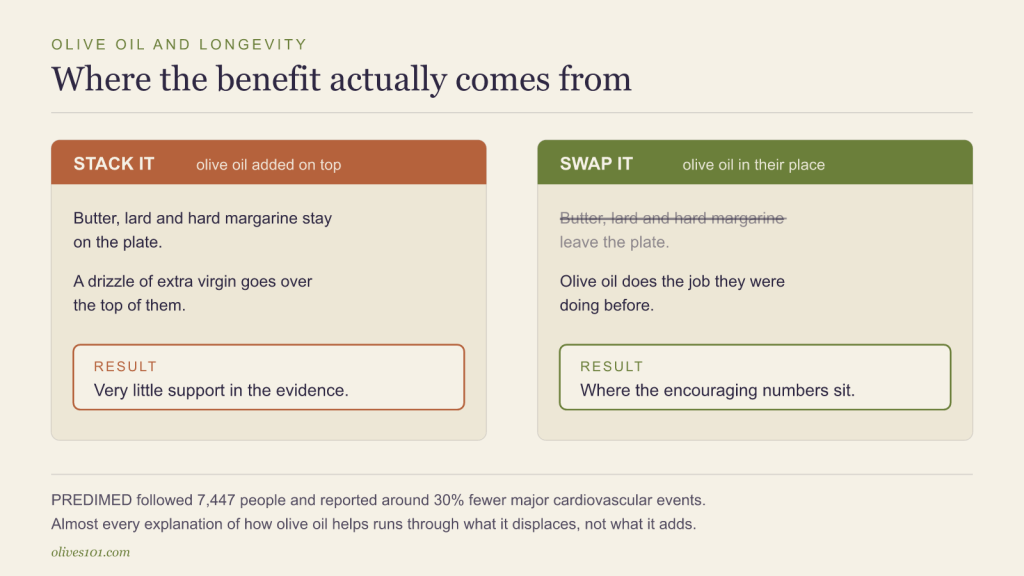
Olive oil is the star of a thousand longevity headlines. The honest picture is more interesting than the hype: the oil earns its reputation mostly through the company it keeps, and through what it pushes off your plate.
Every few months a study lands, a headline follows, and olive oil is crowned again. Somewhere between the marketing and the backlash sits the actual evidence, which is genuinely encouraging and rather more modest than the bottle would have you believe. Having spent a working life around this stuff, I have watched the health story become the industry’s best salesman — and I have watched it get badly overstated. So here is what holds up.
Where the reputation came from
The trail starts with population studies rather than laboratories. From 1958 onward, researchers comparing eating patterns across several countries noticed that people in parts of Greece and southern Italy had strikingly low rates of heart disease despite eating a diet that was not low in fat. The fat was simply different: mostly olive oil, alongside vegetables, legumes, bread, fish and very little red meat. That observation launched sixty years of work on what we now call the Mediterranean pattern.
The strongest single test came much later, with a large Spanish trial that assigned thousands of people at high cardiovascular risk to a Mediterranean diet supplemented with either extra virgin olive oil or nuts, versus advice to eat a low-fat diet. Major cardiovascular events fell by roughly a third in the Mediterranean arms. Worth knowing, and worth saying out loud: that trial was retracted and republished in 2018 after irregularities were found in how some participants were randomised. The reanalysis left the headline result substantially unchanged, but the episode is a useful reminder that nutrition science is messy and that any single study — however famous — deserves a raised eyebrow.
The mechanism nobody puts on the label
Here is the part that gets lost. Olive oil is not a drug you add to your life. Almost every model of how it helps runs through substitution — olive oil in place of butter, margarine, lard and heavily refined blends. When it displaces saturated and industrially hardened fats, the blood-lipid picture tends to improve. When it is simply poured on top of an otherwise unchanged diet, you have added roughly nine calories per gram and not much else.
Beyond the fat itself, extra virgin oil carries phenolic compounds — hydroxytyrosol, oleuropein derivatives, oleocanthal, the things responsible for that peppery catch at the back of the throat. These are genuinely interesting antioxidant and anti-inflammatory molecules, and they are exactly what refining strips out. How much they contribute to human outcomes at ordinary eating quantities is still an open question. Be suspicious of anyone who tells you it is settled.
| The claim | What the evidence supports | Verdict |
|---|---|---|
| Olive oil makes you live longer | Population studies link higher intake to lower cardiovascular and all-cause mortality; trials test whole diets, not the oil in isolation | Plausible, never proven for the oil alone |
| Extra virgin beats refined | Refining removes the phenolic compounds and most of the aroma | Well supported chemically; the clinical size is unclear |
| It is the fat that does the work | Most of the modelled benefit comes from replacing saturated and trans fats | The swap matters more than the spoonful |
| More is always better | It is a fat, at about nine calories a gram, like every other | No — substitute, do not stack |
| Cooking destroys the benefits | Heat degrades phenolics and aroma; the monounsaturated fat itself is comparatively stable | Partly true, and overstated |
What the trade does not shout about
Bottles now advertise polyphenols the way breakfast cereal once advertised vitamins. What they very rarely print is the harvest date — and phenolic content falls steadily with time, light and warmth. An oil pressed from late, overripe fruit, held in a clear bottle under supermarket lights for eighteen months, has quietly lost a great deal of what the health headline is celebrating. Meanwhile the label still says extra virgin, because that grade is set at bottling, not at the moment you buy it.
So the useful health advice is unglamorous and mostly about freshness and handling: buy a dark bottle or a tin, look for a harvest date rather than only a best-before date, buy a size you will finish in a couple of months, and keep it away from the hob. If a bottle is cheaper than the fruit and labour that supposedly went into it, ask why — see what an olive actually costs. This is general information, not medical advice.
| Fat backbone | Olive oil as the main added fat, in place of butter and hardened blends |
|---|---|
| Daily | Vegetables, fruit, whole grains, legumes, nuts |
| Weekly | Fish and seafood; modest poultry, eggs, yoghurt and cheese |
| Occasional | Red and processed meat, sweets, refined grains |
| Unmeasured context | The populations studied also walked a great deal and ate unhurried, shared meals |
| Honest caveat | Observational work cannot fully separate the oil from the life around it |
How to act on this without being silly
- Replace, do not add. The benefit lives in the swap — olive oil where butter or a hardened blend used to be.
- Buy for freshness. Harvest date, dark glass or tin, a bottle you will finish before it tires.
- Keep the good oil raw. Use a decent everyday oil for the pan and save the peppery one for the plate.
- Ignore any single study. Including the famous ones. Patterns over years beat headlines.
- Do not treat it as medicine. It is food, and it belongs to a way of eating, not to a supplement aisle.
Olive oil and longevity: common questions
Does olive oil actually extend life expectancy?
No study can show that for olive oil on its own. What large population studies and diet trials show is that eating patterns built around olive oil are associated with fewer cardiovascular events and lower mortality. The oil is part of the pattern, not a stand-alone treatment.
Is extra virgin worth the extra money for health reasons?
Extra virgin retains the phenolic compounds that refining removes, so on chemistry alone it is the better choice. How much difference that makes at everyday quantities is not settled — but it also tastes far better, which is reason enough.
How much olive oil should I use?
There is no magic dose, and adding it on top of an unchanged diet mostly adds calories. Think in terms of substitution: let it be the main added fat you cook and dress with, rather than an extra.
Does heating olive oil ruin it?
Heat degrades the aromatic and phenolic fraction, so a fine oil is wasted in a hot pan. The monounsaturated fat itself is comparatively stable, which is why olive oil has been used for frying around the Mediterranean for centuries.
Was the famous Mediterranean diet trial discredited?
It was retracted and republished in 2018 because some participants had not been properly randomised. The reanalysed results were broadly similar. It is a caution about trusting any single trial, not a demolition of the wider evidence.
The health story sells more oil than any tasting note ever will, and the trade knows it. That is precisely why you should read the back label rather than the front. The front talks about hearts and antioxidants; the back — if you are lucky — tells you where the olives grew and when they were picked. An old, tired, light-struck bottle of technically extra virgin oil is not the thing the studies were about. Buy fresh, buy small, finish it, buy again. That habit will do more for you than any number on the front of the bottle.
Drawn from the Seven Countries Study literature, the PREDIMED trial (retracted and republished with reanalysed data in 2018), and standard fatty-acid and phenolic composition data for olive oil.