Olive oil: a liquid market
Olive oil looks like a grocery item and behaves like a commodity. Its price is set by weather in a handful of provinces, by a tree with a two-year memory, and by warehouses full of last year’s oil — then reaches you months late.
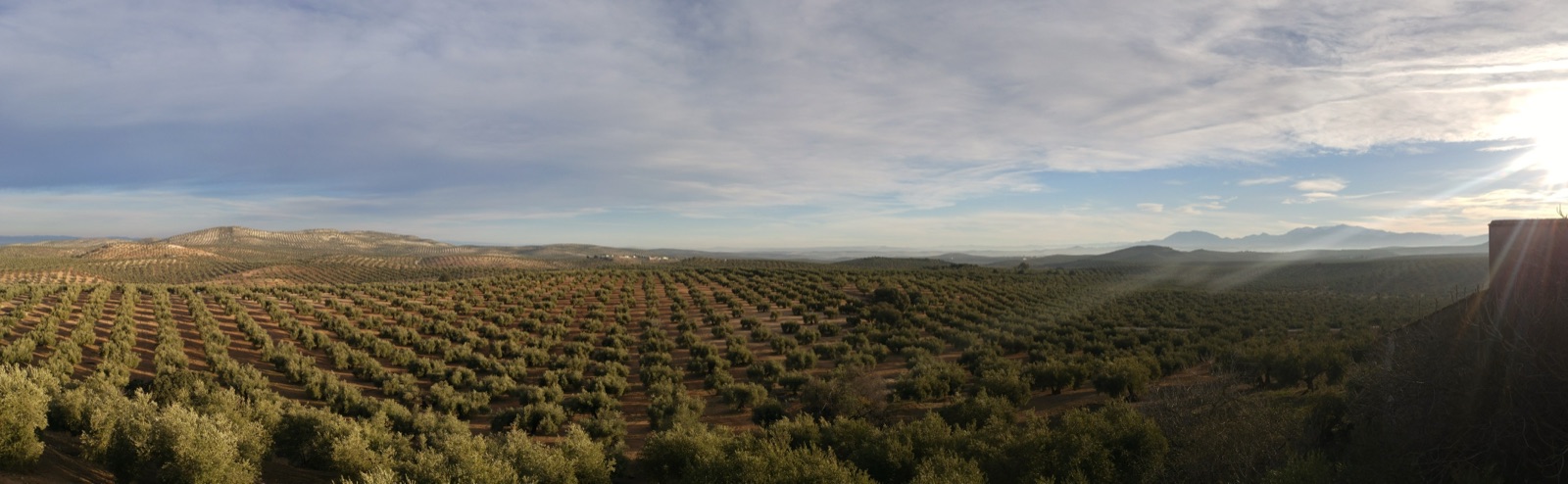
Whenever the price of olive oil moves sharply, the explanations arrive within days and they are always tidy: a drought, a regulation, a speculator, the climate. Some of them are even partly right. But the olive oil market has a structure, and once you understand the structure the price behaviour stops looking mysterious and starts looking almost mechanical. It is a market with one dominant supplier, a crop that alternates by nature, no deep futures market to smooth expectations, and a retail chain that passes changes on slowly and reluctantly.
One country, and really one region, sets the world price
Spain produces around half of the world’s olive oil in a normal year, and the great majority of Spanish oil comes from Andalusia, with Jaén province alone accounting for an extraordinary share. That concentration is the single most important fact in the market. A bad spring in Jaén is not a regional story, it is a global price event. When Andalusian output falls sharply, Italian, Greek and Tunisian oil is bid up too, because buyers who cannot get Spanish volume go looking everywhere else at once.
This is also why individual producer anecdotes are a poor guide. A grower whose own crop halved may be describing a local frost, a pest year, an off-year in the tree’s own rhythm, or a genuine regional drought. From a single grove you cannot tell which — and single-grove stories are exactly what tends to reach the press.
| Driver | How it works | Speed of effect | How reliable an explanation it is |
|---|---|---|---|
| Andalusian harvest size | Roughly half of world supply concentrated in one region | Immediate at origin | Very high — the dominant factor |
| Alternate bearing | Olives naturally crop heavily one year, lightly the next | Predictable, year to year | High, and routinely mistaken for climate |
| Heat or drought at flowering | Spring heat above roughly 35C wrecks fruit set | Same season | High for that year, weak as a trend claim |
| Carry-over stocks | Warehoused oil from previous seasons cushions a bad year | Months | High — the most underrated factor |
| Energy, labour and glass | Picking, milling, bottling and freight costs | Gradual | Moderate — a floor, not a spike |
| Retail contracts | Supermarket prices are negotiated in advance | 3 to 9 months lag | High for explaining why shelves lag origin |
| Speculation and hoarding | Holders delay selling into a rising market | Weeks | Real but usually secondary |
The tree has its own two-year memory
Olives are alternate bearing: a heavy crop exhausts the tree and suppresses the following year’s flowering, so a big year tends to be followed by a small one. Growers manage this with pruning, irrigation and thinning, and modern intensive orchards damp it down considerably, but across a whole country the rhythm is still visible. This matters because it means a fall in production is not automatically evidence of anything except last year’s abundance. Attributing a single small harvest to a long-term cause requires several years of data, not one email from a producer.
None of which means the climate signal is imaginary. Heat during flowering, warmer winters that fail to deliver the chilling olives need to flower properly, and drought during oil accumulation are all real and all documented pressures on Mediterranean growing. The honest position is that the trend is worth taking seriously and any single season is a terrible piece of evidence for it.
Why your supermarket is always late
Origin prices move first, in the bulk market where mills, cooperatives and packers trade. Retail prices move last, because supermarket supply contracts are negotiated in advance and neither side wants to reopen them. In practice a harvest shock reaches the shelf several months later, and comes back down even more slowly — price rises pass through faster than price falls, which is not unique to olive oil but is very visible in it.
There is also a quiet quality consequence. When origin prices spike, the incentive to stretch, blend down or relabel grows sharply, and enforcement cases tend to follow high-price years. If you shop through a shortage, pay more attention to grade and origin than usual, not less. It is precisely when good oil is expensive that bad oil gets creative — see how olive oil is cut.
What to do with all this
- Watch Spain, not your own country. Andalusian rainfall in spring tells you more about next year’s price than anything local.
- Discount single-producer stories. One grove is an anecdote; a region is data.
- Expect a lag. Origin prices and shelf prices are months apart in both directions.
- Buy quality, not litres, in a spike. Cheap oil in an expensive year is the highest-risk purchase on the shelf.
- Stock modestly, store properly. Cool, dark, sealed — hoarding oil that oxidises saves nothing.
- Read a price rise as information about weather and stocks, not as proof of anyone’s virtue or villainy.
Olive oil prices: common questions
Why is olive oil so expensive some years?
Usually because the Spanish harvest was poor and carry-over stocks were already low. Because Spain supplies around half of world output, a bad Andalusian season lifts prices everywhere at once.
What is alternate bearing?
The olive tree’s natural tendency to produce a heavy crop one year and a light one the next. It means a small harvest is often a normal biological rebound rather than evidence of a crisis.
How quickly do harvest problems reach the shelf?
Typically several months. Bulk prices at origin move first; supermarket prices follow when supply contracts are renegotiated, and they fall back more slowly than they rise.
Is climate change raising olive oil prices?
Heat at flowering, milder winters and drought are genuine and documented pressures on Mediterranean production. But any single bad season is weak evidence on its own, because normal alternate bearing produces the same pattern.
Should I stockpile olive oil when prices rise?
Only modestly. Olive oil degrades with light, heat and air, so buying a year’s supply that oxidises in a warm kitchen costs more than it saves. Buy what you will use in a few months and store it cool and dark.
Here is the part that never makes the price story. A shortage does not just make oil dearer — it changes what is in the bottle. Blends get quietly reformulated, the proportion of the cheapest available origin rises, and oil that would have been rejected in a fat year finds a home. The label does not change. So in an expensive year, do the opposite of what feels prudent: buy less, buy better, buy dated, and buy from someone who will tell you which mill it came from. Trading down during a price spike is how people end up concluding that they do not much like olive oil.
Drawn from published olive oil production and stock statistics, standard agronomic accounts of alternate bearing, and observed pass-through behaviour between origin and retail prices.