Australia Fines ‘Extra Virgin’ Oil That Was 93% Canola
Australia’s consumer watchdog has fined an importer A$20,400 over tins sold as “Extra Virgin Olive Oil” and “100% Olive Oil” that were in fact 93 percent canola oil. The Australian Competition and Consumer Commission (ACCC) announced on June 3 that MOI International had paid two infringement notices. Here is what was on the tin, why it slipped through, and the one habit that protects you from this kind of label.
What happened
MOI International (Australia), a Queensland-based importer, brought in an oil called “Mediterranean Blend” from Malaysia and sold it in 3-liter tins during 2012 and 2013. The front of the tin prominently said “Extra Virgin Olive Oil” and “100% Olive Oil”. The fine print on the side told a different story: 93 percent canola oil and just 7 percent extra virgin olive oil.
The ACCC took the view that the prominent claims misrepresented what was in the tin, and the company paid two infringement notices totaling A$20,400. As the regulator is careful to point out, paying an infringement notice is not an admission that the law was broken. According to Olive Oil Times, the company paid on May 30, and the Australian Olive Association had brought the product to the ACCC’s attention after a consumer sent in a tin.
“The term ‘extra virgin’ is widely understood by consumers to mean a premium product,” ACCC chairman Rod Sims said. “Consumers should be able to trust that what’s on the label is what’s in the bottle when making purchasing decisions.”
Why it matters
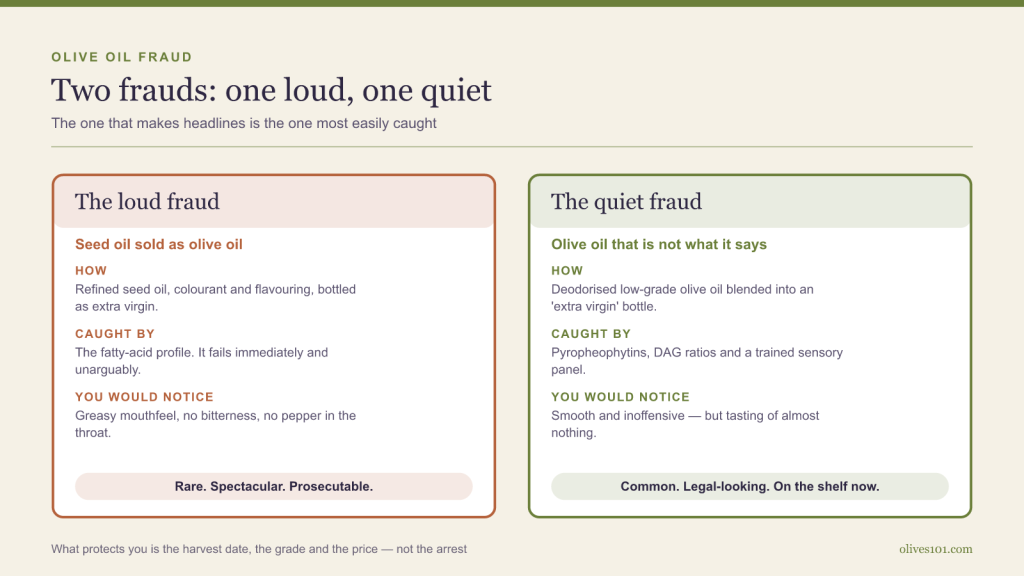
This is the loud kind of olive oil fraud: a cheap seed oil sold under an olive oil name. It is not subtle and it is not hard to catch in a lab. What makes it work is that most shoppers read the big words on the front and never turn the tin around.
It also shows the gap in Australian rules. Australia has a voluntary national standard for olive oil, AS 5264-2011, but no mandatory definition of extra virgin. The ACCC acts under general consumer law against misleading claims, and it says it is widely accepted that extra virgin is the highest grade, from the first press of good olives, not blended with other oil and made without solvents or refining. The Australian Olive Association’s chief executive, Lisa Rowntree, was quoted as disappointed that more was not being done about adulteration and that the ACCC did not treat the national standard as mandatory.
| Case | What the label claimed | Penalty |
|---|---|---|
| MOI International, announced June 2013 | “Extra Virgin Olive Oil” and “100% Olive Oil” on a 93 percent canola blend | Two infringement notices, A$20,400 |
| The Big Olive Company, May 2012 | “Extra virgin olive oil” the ACCC considered was not | Two infringement notices, A$13,200 |
What it means for buyers
A blend of canola and olive oil is a perfectly legal product. Plenty of cooks use one for frying. The problem is only ever the label. So the defense is simple, and it works in any country:
- Turn the container around and read the ingredients or composition line before the price.
- Be wary of “100%” next to a grade name on a large, cheap tin. Real extra virgin has a cost floor.
- If a product has to explain itself in small print on the side, believe the small print.
The side panel is where honest disclosure and dishonest marketing meet. A packer who wants to stay legal on paper puts the true composition somewhere on the container, then designs the front so that nobody reads it. In the trade we used to say the front label is written by marketing and the back label by the lawyers. Read the lawyers’ version.
Sources
- ACCC: MOI International pays for misleading olive oil claims (June 3, 2013)
- Olive Oil Times: Australian Company Fined for Deceptive Olive Oil Labeling (June 4, 2013)