Britain’s Traffic Light Label Gives Olive Oil Two Reds
Britain launched its agreed front-of-pack food label this week, the red, amber and green scheme that most big supermarkets and several large manufacturers have signed up to. Judged by its rules, a bottle of extra virgin olive oil earns two red lights. Here is how the scheme works, why olive oil scores badly, and what that does and does not tell a shopper.
What was announced
On June 19 the Department of Health unveiled the final design of the consistent front-of-pack nutrition label, presented by public health minister Anna Soubry. It combines color coding with the numbers: calories and the grams of fat, saturated fat, sugars and salt in a portion, with colors showing whether the amount per 100 grams is high (red), medium (amber) or low (green).
The scheme is voluntary, but the sign-up is broad. Sainsbury’s, Tesco, Asda, Morrisons, the Co-operative and Waitrose are all in, and on the day of the launch Mars UK, Nestlé UK, PepsiCo UK and Premier Foods said they would use it too. Soubry said research shows people prefer this label to the alternatives, and the department stressed that the labels are “not designed to demonise foods with lots of reds”.
Why olive oil gets two reds
The thresholds come from the government’s own guidance, published this month. For solid foods, anything above 17.5 grams of fat per 100 grams is red, and anything above 5 grams of saturated fat per 100 grams is red as well.
| Per 100 g | Green (low) | Red (high) | Olive oil |
|---|---|---|---|
| Fat | 3.0 g or less | More than 17.5 g | 100 g, red |
| Saturates | 1.5 g or less | More than 5.0 g | About 14 g, red |
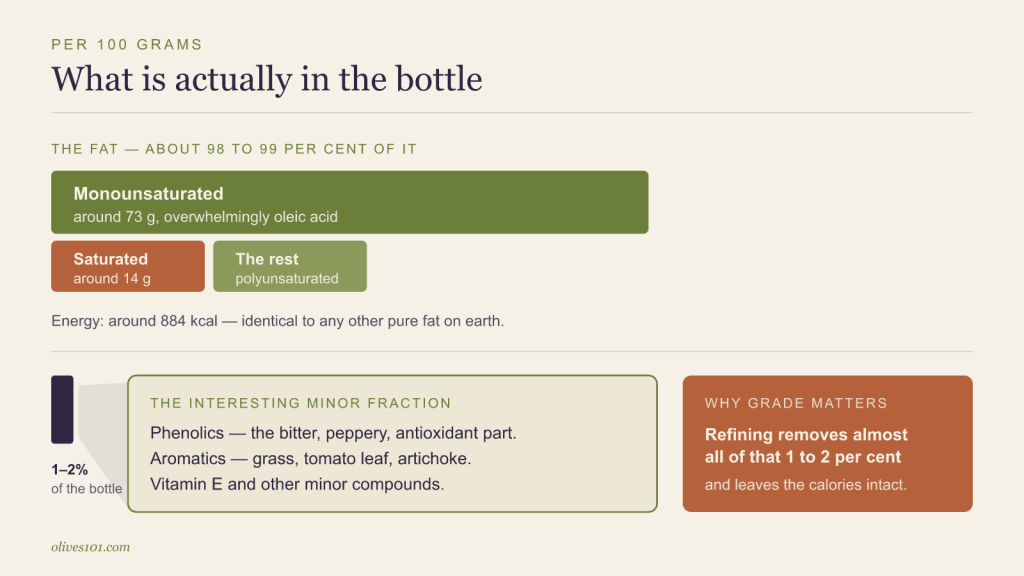
Olive oil is pure fat, so the first red is unavoidable. The second comes from its saturated fraction, roughly 14 grams in 100, which is low for a fat but four times the red threshold. The scheme makes no distinction between saturated and unsaturated fat beyond those two lines, so the three quarters of olive oil that is monounsaturated earns it nothing at all.
The same arithmetic catches most of the Mediterranean larder: hard cheese, cured ham, nuts, tahini and every other cooking oil on the shelf. It is a consequence of judging a food by 100 grams of itself rather than by the amount anyone actually eats. Nobody drinks 100 grams of olive oil. A tablespoon is about 14 grams, and it usually replaces butter, cream or a seed oil rather than being added to them.
What it means in practice
- Nothing changes in the bottle. This is a labeling scheme, and a voluntary one.
- Color coding is designed for comparing like with like, one ready meal against another, not for judging a cooking ingredient on its own.
- Producers in southern Europe will not enjoy watching their flagship product stamped red in Britain, and the argument about whether such schemes fit European labeling law is not going away.
- For shoppers, the useful part of the label is the numbers, not the colors. For olive oil the numbers have been the same for a few thousand years.
This is general information, not medical advice. If you have been told to change how much fat you eat, follow your doctor or dietitian rather than a color on a bottle.
The label tells you nothing about the only thing that separates one olive oil from another: whether it is fresh, whether it is really extra virgin, and how it tastes. Two bottles on the same shelf, one a superb single-estate oil and one a tired blend near the end of its life, get identical colors, because their fat composition is near enough identical. The traffic light is a nutrition tool. Quality is still your problem.