Flavored Oils Are Condiments, Not Olive Oil, Says IOC Panel
Flavored olive oil is not olive oil in the eyes of the International Olive Council’s advisory committee: its members agreed that oils with added lemon, garlic, herbs and the like should be called condiments and fall outside the IOC trade standard. The view appears in the IOC’s May market newsletter, published this week, alongside figures showing world olive oil imports down and Spanish prices sharply lower. Here is what the council said, and what it means for shoppers and for the trade.
Flavored oils: “condiments or something similar”
The IOC Advisory Committee on Olive Oil and Table Olives, which brings together producers, consumers, processors and traders, held its 43rd meeting in Split, Croatia, on May 22, with observers from Australia, Brazil, India, Japan and the United States. Among other things it discussed flavored oils. The common opinion, the newsletter says, was that these oils “should be termed condiments or something similar and do not fall under the scope of the IOC trade standard”.
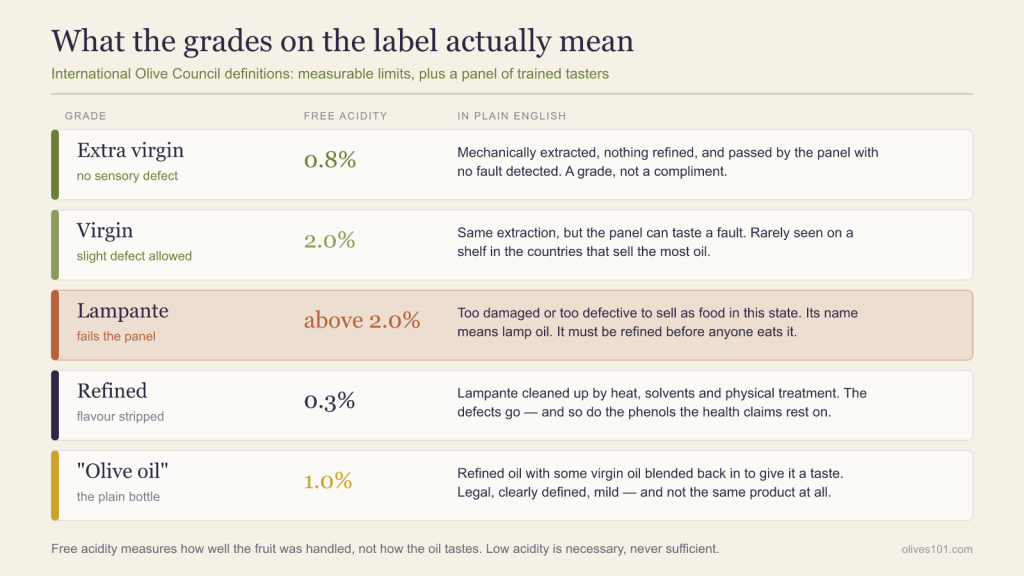
The reasoning is simple. Under the standard, virgin olive oil is oil extracted from olives by mechanical or physical means only, with no additives allowed. The grade sold simply as “olive oil” is a blend of refined and virgin olive oil, and the only thing that may be added is up to 200 mg/kg of alpha-tocopherol to replace what refining removes. Nothing else. Oil with garlic or lemon in it therefore cannot be extra virgin, or any other olive oil grade, however good the base oil was.
The committee asked the IOC Council of Members to remind member countries of these rules and to invite them to adopt national regulations labeling flavored oils as condiments or preparations. The newsletter also describes a new procedure for publicizing proposed changes to the IOC’s testing methods and limits, with comments invited until September 8, 2014.
The market: less trade, a wide price gap
The same newsletter, drawing on figures presented at the Council’s 22nd extraordinary session in Madrid from June 2 to 6, gives a snapshot of a season shaped by Spain’s huge harvest.
| IOC May 2014 newsletter | Figure |
|---|---|
| World production 2013/14 | Up 28% on 2012/13 |
| Spain | 1,770,000 tons (+187%) |
| Italy / Greece / Portugal | 350,000 t (-16%) / 135,000 t (-63%) / 90,000 t (+52%) |
| Imports, 7 markets, Oct. 2013 to March 2014 | Down 7.4%, to 278,888 tons |
| Spanish extra virgin, ex-mill, late May | €1.98/kg, down 28% on a year earlier |
| Italian extra virgin, ex-mill, end of May | €3.61/kg, up 14% |
Imports rose in Russia (+6%) and Japan (+2%) but fell in China (-28%), Brazil (-12%), Australia (-9%), the United States (-7%) and Canada (-4%). In the first five months of the season, EU purchases from outside the Union dropped by about a third, which the IOC calls only logical given Spain’s crop. Greek extra virgin stood at about €2.49/kg at the end of May, up 6%.
The council also confirmed plans to hold two editions of its Mario Solinas quality award in 2015, in January and June, to attract entries from a wider spread of countries, with the prize-giving at New York’s Summer Fancy Food Show. It is running an educational seminar at this year’s show on June 30.
What it means on the shelf
The IOC has no police powers; its opinion only bites where countries write it into their own rules. So for now, expect to keep seeing “extra virgin olive oil with lemon” on labels. The price figures matter more to most shoppers. With Spanish extra virgin at under €2 a kilo at the mill and Italian oil at well over €3.50, the gap between the two is unusually wide, and blends sold under a vague “EU” origin are likely to lean even harder on Spanish oil this year.
Flavoring is the kindest thing that can happen to a mediocre oil. Garlic, chili or citrus covers the defects a taster would catch at once, which is why the base oil in many flavored bottles is nothing special. If you like them, buy from a producer who names the base oil and its harvest, or make your own at the table from good extra virgin. If you infuse garlic or herbs in oil at home, keep it in the fridge and use it within a few days, because homemade garlic-in-oil is a known botulism risk.
Sources
- International Olive Council: Market Newsletter, May 2014 (published June 11, 2014)
- International Olive Council, Market Newsletter No 83, May 2014 (PDF)
- Olive Oil Times: Olive Council Reports on Flavored Oils, Fall in World Trade (June 11, 2014)