Shaking up olives
Somebody, somewhere, is right now putting a new flavour on an olive. Most of it is harmless fun and some of it is genuinely good. But a marinade is also the most effective way ever devised to sell fruit that would not survive being tasted plain.
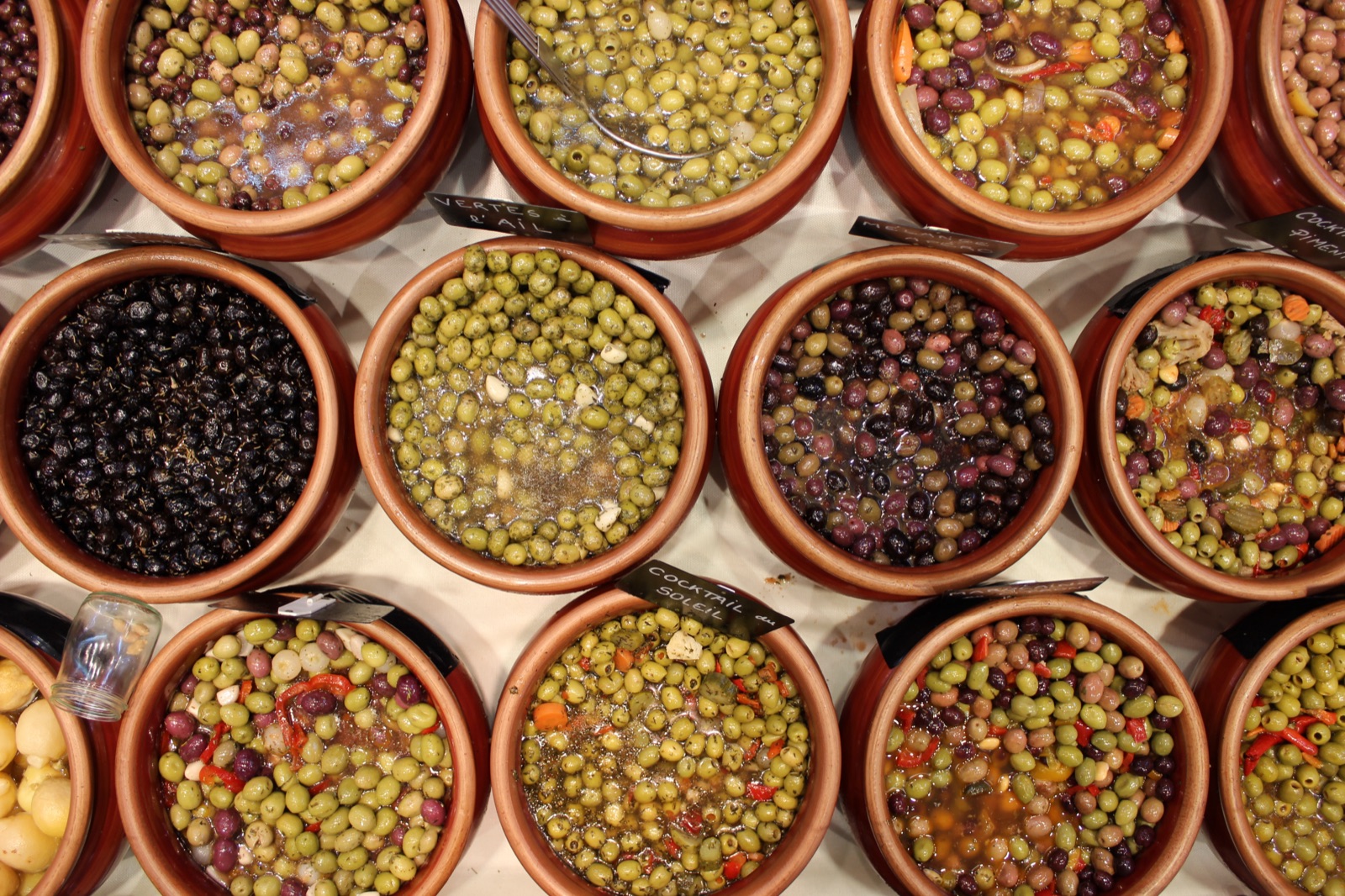
The flavoured olive is one of the great small businesses of the food world. Someone tastes a marinade, thinks it would work on olives, buys a drum of plain fruit, and starts. That is a real and honourable trade, and some of the results are excellent — a good chilli-and-garlic marinade on firm green olives is a genuine pleasure, and a lot of regional preparations that we now think of as traditional started as exactly this kind of experiment. But it is also the corner of the aisle where the gap between what you are shown and what you are sold is widest, so it is worth understanding how it actually works.
What a marinade can hide
Start with the uncomfortable structural fact: plain olives are judged on texture, on the cleanness of the brine and on the fruit itself. Flavoured olives are judged on the flavouring. That difference is worth money, because it means fruit that is soft, over-brined, oxidised or simply dull can be rescued commercially by a bath of garlic, chilli, herbs, citrus zest and acidity.
I am not saying every flavoured olive is a cover-up — plenty of producers marinate good fruit because marinated olives sell. But if you have ever wondered why a tub tastes intensely of everything except olive, that is your answer, and it explains why the trade’s own rule is so simple: taste the plain version of the same fruit before you judge the flavoured one. If the plain olive is good, the marinade is a decoration. If you are never offered the plain olive, the marinade is the product.
Stuffed olives, honestly
Stuffing deserves its own paragraph because so much of it is misunderstood. Pepper is far and away the most common stuffing in Europe, and at the cheap end the pepper is not a piece of pepper at all — it is a reconstituted paste, extruded into the cavity by machine, and its ingredient list is usually more interesting reading than its flavour. The hand-stuffed article, made with an actual strip of roasted pepper, still exists and costs what handwork costs.
Anchovy stuffing is a different case, and worth knowing about: it is essentially always made with cured, canned anchovy rather than fresh fish, and that is a food-safety decision rather than a cost-cutting one. Almond stuffing is the third classic and the easiest to check — an almond either is or is not a whole almond. And then there is the American end of the trade, which stuffs olives with a range that startles a European visitor: blue cheese, jalapeño, garlic, citrus, habanero, and combinations invented last season. The variety is real, the quality range is enormous, and the good ones are very good.
The deli bar, and what it really is
Now the part that annoys people when I say it out loud. The glistening olive bar at the front of a good food shop, with its little tongs and its handwritten signs, is very often the same industrial product as the jar on the shelf behind you — bought in buckets or drums, decanted into shallow trays, dressed with a scatter of herbs and rebranded as freshly prepared by the theatre of the display alone.
Not always. There are shops that genuinely prepare their own, and they are usually delighted to tell you so in detail. But the default assumption should be the bucket, and the bar carries a real disadvantage the jar does not: open trays sit in air and under lights, the surface fruit dries and oxidises, and unless the shop turns its stock briskly you are paying a premium for older fruit than the sealed jar contains. The right question at the counter is not whether it is fresh — everyone says yes — but when this tray was filled.
| Style | What it usually is | What to check |
|---|---|---|
| Herb & garlic marinade | Plain brined olives dressed in oil, herbs and aromatics | Taste the same olive plain first; look for firm flesh |
| Chilli / spiced | Often good; heat and acidity dominate the palate | Whether any olive flavour survives the seasoning |
| Pepper-stuffed | Commonly a reconstituted pepper paste, machine-filled | The ingredient list; hand-stuffed strips cost more and say so |
| Anchovy-stuffed | Cured canned anchovy, for food-safety reasons | Salt level; the fish should season, not overwhelm |
| Almond-stuffed | Whole almond in a large green olive | That the nut is whole and not stale |
| Deli-bar olives | Frequently bulk product decanted into trays | When the tray was filled, and how fast the shop sells |
How to buy flavoured olives well
- Taste plain before flavoured. It is the single test that tells you whether you are buying fruit or seasoning.
- Look at the brine, not the olives. Cloudy, ropey or foamy liquid is a warning regardless of how good the herbs look on top.
- Prefer unpitted where you can. A pitted olive is a fruit with a hole in it that fills with brine and softens faster. Many of the best table olives are sold with the stone in.
- Ask when the tray was filled. Not whether it is fresh. The answer to the second question is always yes.
- Read the stuffing. Pepper paste, whole pepper strip and whole almond are three different products at three different prices.
- Buy small and often. Dressed olives are at their best within days of being dressed, not weeks.
Flavoured and stuffed olives: common questions
Are marinated olives lower quality than plain ones?
Not necessarily, but marinating makes quality much harder to judge. Strong seasoning can mask soft texture and dull or oxidised fruit, which is why tasting the plain version first is the reliable test.
What is the pepper in pepper-stuffed olives?
At the inexpensive end it is usually a reconstituted pepper paste filled by machine, not a piece of roasted pepper. Hand-stuffed olives with a genuine pepper strip exist and cost noticeably more.
Why is anchovy stuffing always cured or canned?
Because processed, salt-cured anchovy is the safe way to combine fish with a product stored in brine at ambient temperature. It is a food-safety choice rather than a cost-saving one.
Are deli-bar olives fresher than jarred olives?
Often not. Much bar stock arrives in bulk buckets and is decanted into trays, where it sits open to air and light. A sealed jar can easily be the fresher product.
Should I buy pitted or unpitted olives?
Unpitted keeps texture and flavour better, because the flesh is intact. Pitted is more convenient for cooking, but the cavity takes on brine and the fruit softens sooner.
Here is the thing I most want people to know about the olive counter, and nobody in the trade will thank me for it: the pretty bar and the plain jar are frequently the same fruit, out of the same bucket, from the same processor — one of them just got tongs, a hand-written card and a fifty per cent premium. That is not fraud and I am not calling it one. It is display. But once you have seen the delivery arrive in drums, you stop paying for the theatre and start asking the only useful question, which is what the plain olive underneath tastes like. Get that right and the marinade is a bonus. Get it wrong and you are eating garlic and oregano at olive prices.
Drawn from long familiarity with table-olive processing and distribution practice in Europe and the United States, and standard commercial preparation of stuffed and marinated olives.