The World’s Biggest Olive Oil Producers
Most people assume Italy makes the most olive oil, because that is what the bottles say. They are wrong. Here is how the world’s oil actually breaks down, country by country, and why the flag on the front so often misleads.
Olive oil feels like an Italian thing, and the marketing works hard to keep it that way. But production is a different map from reputation. A handful of countries around one sea grow the overwhelming majority of the world’s olives, a few of them make far more than they ever bottle under their own name, and the crop swings so hard from year to year that the ranking below the leader reshuffles almost every harvest. Knowing who actually grows what is the first real defence against a misleading label.
| Country | Roughly where it sits | What to know |
|---|---|---|
| Spain | The runaway leader — often close to half of all olive oil on earth | Most of it flows from the Picual seas of Jaén in Andalusia. No one else is remotely close. |
| Italy | A major producer — but a bigger bottler | Italy imports enormous volumes to blend and re-export. ‘Italian’ on the front often means bottled, not grown, there. |
| Greece | A heavyweight, punching above its size on quality | Dominated by Koroneiki; a high share is extra virgin, though much still leaves in bulk. |
| Tunisia | The largest producer outside the EU | The quiet giant. Vast groves of Chemlali and Chetoui; a great deal is shipped north to be blended anonymously. |
| Türkiye, Morocco, Portugal | All major, order shuffling yearly | North Africa and the eastern Mediterranean are serious players, not bit-part actors. |
| USA, Argentina, Chile, Peru, Australia | The new world | Real, sometimes excellent oil now comes from five continents, not one sea. |
The clear leader, and it is not close
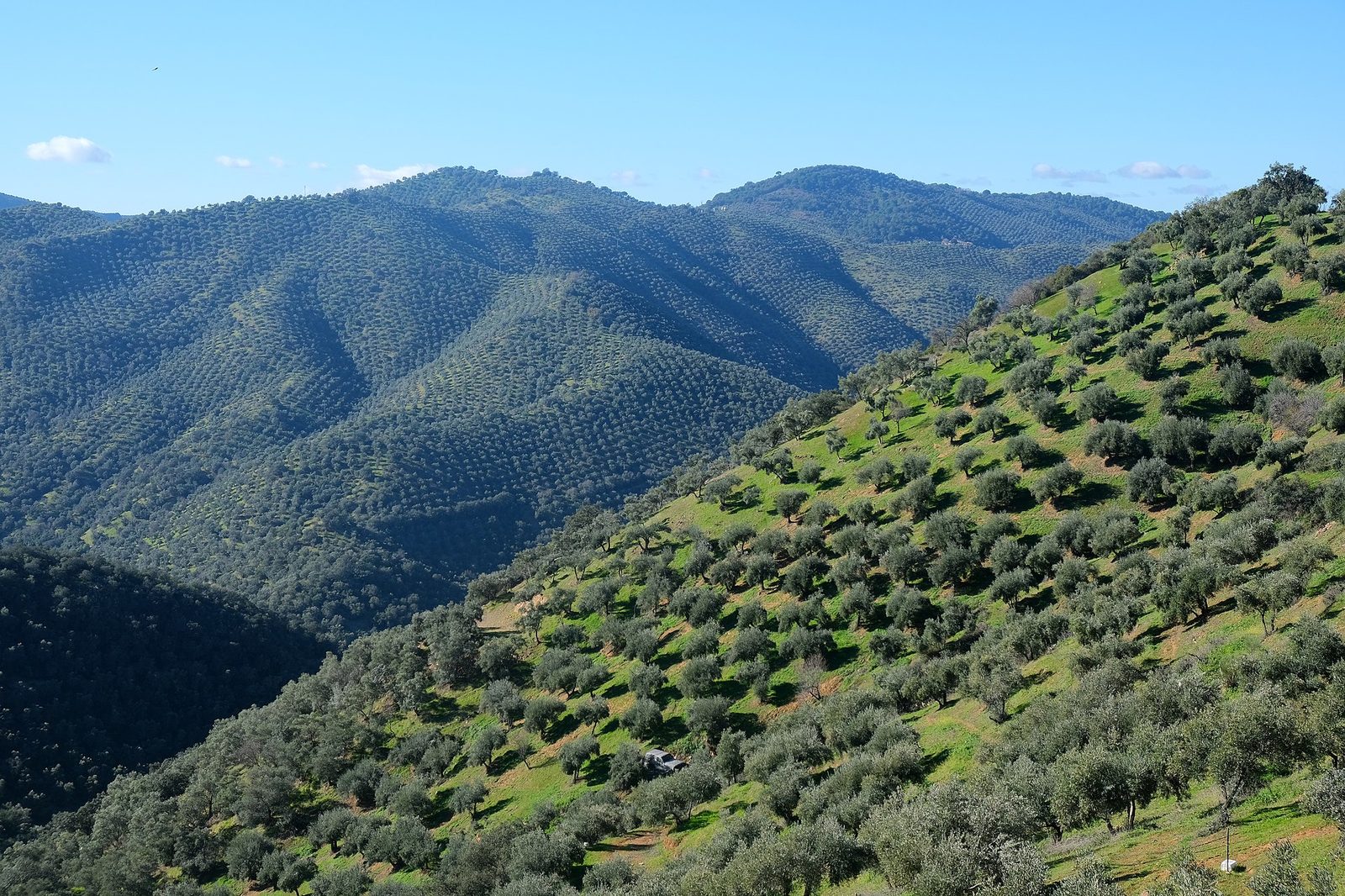
Spain is, by a wide margin, the world’s largest producer, in a strong year making close to half of all the olive oil on the planet. The engine room is Andalusia, and above all the province of Jaén, an ocean of Picual trees stretching to the horizon. When the Spanish harvest is good, world prices soften; when drought hits Jaén, as it did in the poor seasons of the early 2020s, the whole world feels it at the till. That single fact tells you how concentrated this trade really is.
The next tier, and the one that surprises people
After Spain come Italy and Greece — and then the name that stops people short: Tunisia. It is the biggest producer outside the European Union, with huge plantings of Chemlali in the centre and south and Chetoui in the north. Alongside it, Türkiye, Morocco and Portugal are all major makers. Their exact order changes every year with the rain, but the point stands: North Africa and the eastern Mediterranean are production heavyweights, whatever the supermarket shelf implies.
Beyond the old sea
The map keeps growing. California presses serious oil; Argentina, Chile and Peru have real industries; Australia and New Zealand make award winners in a mirror-image southern-hemisphere harvest, pressing their fruit in April and May while Europe waits for autumn. None of this rivals Spain in volume, but it has broken the idea that good olive oil can only come from one shore. The plant travels well, and it has.
| Undisputed leader | Spain, ~40% of world output in an average year |
|---|---|
| Producer bloc | The EU makes roughly two thirds of the world’s oil |
| Biggest non-EU maker | Tunisia |
| Other majors | Italy, Greece, Türkiye, Morocco, Portugal |
| New-world oil | USA (California), Argentina, Chile, Peru, Australia |
| The catch | Producing country and bottling country are often different |
What a buyer should take from this
- The country on the front label is not proof of origin — look for a stated growing region, not just a bottling address.
- A famous flag can hide humbler, cheaper olives; a humble flag sometimes hides excellent ones.
- Spain’s harvest sets the world price — a drought in Jaén reaches your kitchen.
- Great oil now comes from many countries; judge the bottle, not the postcode.
World olive oil producers: common questions
Which country produces the most olive oil?
Spain, by a wide margin — in an average year close to 40% of all the olive oil made on earth, most of it from Andalusia and the province of Jaén.
Isn’t Italy the biggest producer?
No. Italy is a major producer but an even bigger bottler: it imports large volumes to blend and re-export, which is why so much oil wears an Italian label without being grown there.
Who is the biggest producer outside Europe?
Tunisia. It has vast groves of Chemlali and Chetoui and exports a great deal in bulk, much of it blended and bottled elsewhere under other flags.
Does olive oil only come from the Mediterranean now?
No longer. California, Argentina, Chile, Peru and Australia all press real, sometimes excellent oil, with the southern hemisphere harvesting in autumn’s mirror season around April and May.
Why does the country on the label mislead?
Because oil is routinely shipped in bulk and bottled far from where it grew. A label can state where a bottle was filled without telling you where the olives were grown.
Here is the catch that ties it all together. Spain, Greece and Tunisia produce far more oil than they ever bottle under their own names — much of it leaves in tankers to be blended and bottled elsewhere, often in Italy, and sold wearing a more famous flag. So ‘Italian’ on the front frequently means ‘bottled in Italy from olives grown somewhere else’. The real producing giant might be on the back label in tiny type, or nowhere at all. Learn to read past the flag and you stop paying a premium for someone else’s reputation.
Drawn from International Olive Council production data and standard country statistics; year-to-year rankings vary with the harvest.