Port Lincoln, South Australia: Record olive harvest expected
A record harvest after a failed one is the most ordinary thing in olive growing. Behind it sit alternate bearing, drought stress, one shared harvester and seven growers watching the same fortnight in April.
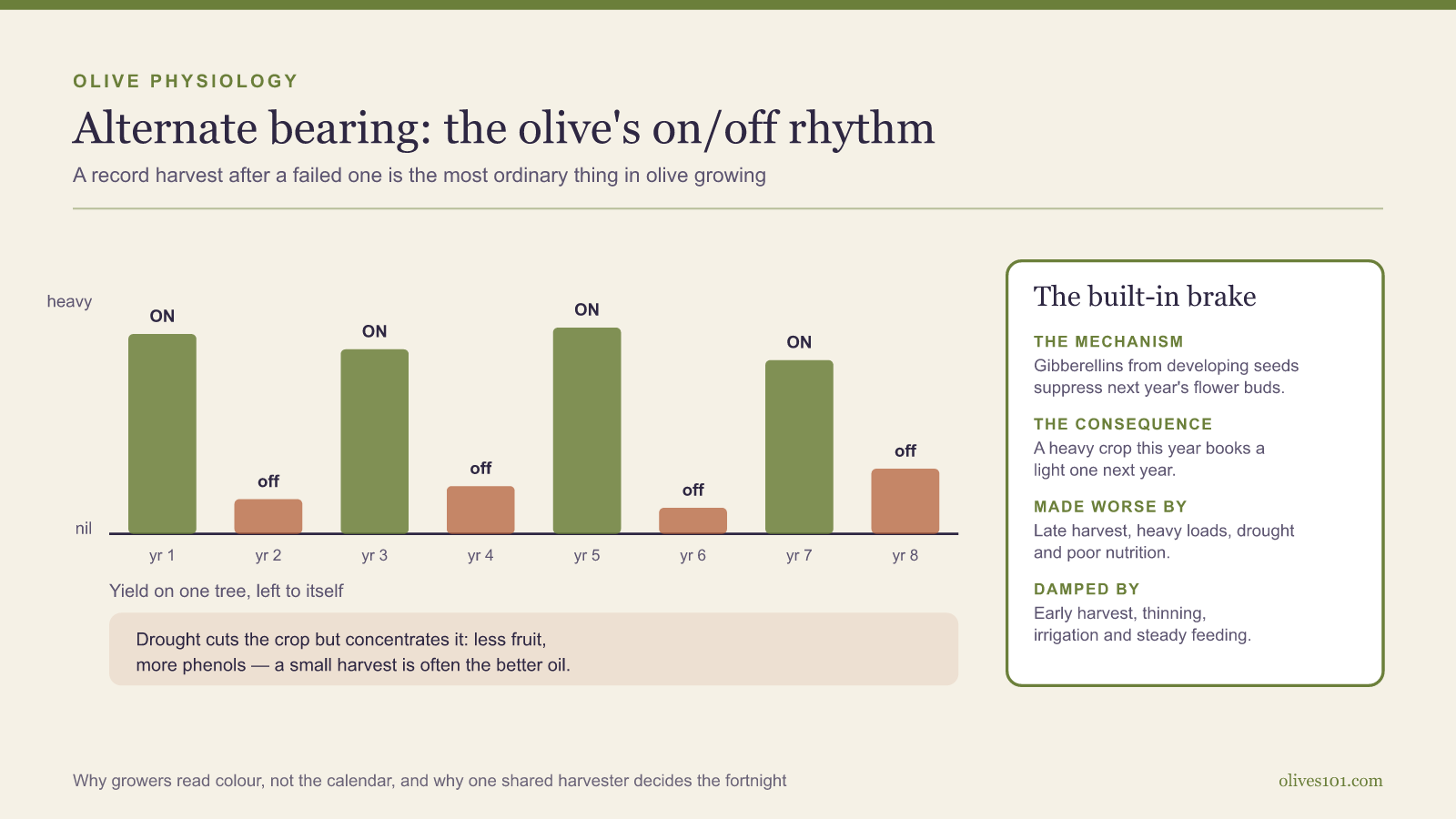
Talk to any grower after a bumper year and you will hear the same slightly nervous optimism: the trees are loaded, the branches are bending, the oil is going to be wonderful. What they will not say, because everyone in the room already knows, is that next season will probably be thin. The olive has a two-year rhythm, and no amount of good weather cancels it.
Alternate bearing, properly explained
Olives fruit on wood grown the previous year. That single fact drives everything. A heavy crop consumes the tree’s resources and, more importantly, suppresses the vegetative growth that would have carried next spring’s flowers. Fewer new shoots means fewer nodes means fewer flowers means a light crop — and a light crop leaves the tree free to grow shoots again, setting up the next heavy year.
There is also a chemical brake. The developing seed inside the fruit produces gibberellins, plant hormones that inhibit floral induction. A tree carrying a heavy load is, in effect, chemically told not to bother flowering next season. Researchers describe this as an alternate-bearing signal that can override the winter chill cue that normally triggers flowering.
Growers manage it rather than cure it. Harvesting early, before the seed is fully developed, reduces the inhibitory signal. Pruning in the heavy year removes fruiting wood and forces vegetative growth. Careful thinning and good nutrition even out the swing. None of it abolishes the cycle — it damps it, and turns a boom-and-bust into something a business can plan around.
| The pattern | A heavy ‘on’ year followed by a light ‘off’ year |
|---|---|
| Why | Fruit suppresses the shoot growth that carries next year’s flowers |
| The chemical brake | Gibberellins from developing seeds inhibit floral induction |
| Made worse by | Late harvest, heavy loads, drought, poor nutrition, no pruning |
| Managed by | Earlier harvest, pruning in the on year, thinning, irrigation and feeding |
| Regional effect | Whole districts can synchronise after a shared shock such as drought or fire |
| What it means for oil | Off-year fruit is often smaller and more concentrated; on-year oil can be diluted by sheer volume |
Drought: less fruit, better oil
Growers coming out of a dry season often say the oil was the best they had made, and the chemistry backs them. Water stress reduces fruit size and number, so tonnage falls — but the fruit that remains has proportionally less water, more oil, and notably more phenolic compounds. Those phenols are the bitterness and the peppery catch, and they are also what keeps the oil from going rancid.
This effect is so dependable that it has become a technique. Deliberately withholding irrigation at chosen points in the season — regulated deficit irrigation — is used to raise phenol levels on purpose. The trade-off is real, though: less oil, stressed trees, and a knock-on into the following season. A drought year makes a superb oil and a poor balance sheet.
A district can also synchronise. After a shared shock — a drought, a fire, a hard frost — every grove in a region recovers on the same clock, so an entire region swings together. That is why regional harvest records tend to arrive in dramatic jumps rather than gentle increases.
One harvester, seven growers
Here is the part that never makes the harvest reports. In a small growing region, nobody can justify owning a mechanical harvester alone. So a machine is bought jointly, or one grower owns it and contracts it out, and every grove in the district queues for the same short window.
That queue is the real constraint. Olives do not wait: once a variety hits the right colour, you have a fortnight, perhaps less in a heat spell, before the fruit softens, the oil quality slides and the mill starts marking you down. Frantoio ripens earlier than most, so it comes off first; a heatwave can push several varieties into the same week and make the schedule collapse. Add the mill’s own capacity — because oil quality is set by hours between picking and crushing — and a regional harvest becomes an exercise in logistics as much as agriculture.
It is also why small regions punch above their weight on quality when they get it right. Everything is close. Fruit picked on the peninsula in the morning can be paste that afternoon, which is a luxury a large operation shipping fruit across a state does not have.
What growers and buyers should take from it
- Judge a grove over two years, not one. A single record harvest says little; the average across an on-and-off pair says everything.
- Pick on colour, not on the calendar. Heat can advance ripening by a fortnight and different varieties will not wait for each other.
- Harvest earlier in a heavy year. It reduces the hormonal brake on next season’s flowering, and earlier fruit makes more phenolic oil anyway.
- Expect drought-year oil to be bitter and long-lived — and expect there to be much less of it.
- For buyers: a light year is not a bad year. Small, stressed fruit often makes the most interesting oil of the decade.
- Ask about the milling gap. Hours between picking and crushing predicts quality better than almost anything else.
Harvest swings and alternate bearing: common questions
Why do olive trees crop heavily one year and barely the next?
Because olives fruit on the previous year’s wood. A heavy crop suppresses new shoot growth and releases hormones from the developing seeds that inhibit flowering, so the following spring produces few flowers — which then frees the tree to grow shoots and set up another heavy year.
Can alternate bearing be prevented?
Not abolished, but damped considerably. Harvesting earlier, pruning in the heavy year, thinning fruit, and steady irrigation and nutrition all reduce the swing. Growers aim for a manageable oscillation rather than a flat line.
Does drought really make better olive oil?
It concentrates it. Water stress cuts yield but raises the proportion of oil and phenolic compounds, giving more bitterness, more pungency and better keeping. The cost is tonnage, tree stress and a weaker following season.
Why do small regions share harvesting machinery?
Because a mechanical harvester is far too expensive for a small grove used a few weeks a year. Shared or contracted machines are the norm — which means every grower in the district competes for the same narrow ripening window.
How quickly must olives be milled after picking?
As fast as possible — ideally the same day. Fruit begins fermenting and degrading immediately, free acidity rises, and quality falls with every hour of delay. Time to the mill is one of the strongest predictors of the grade an oil will achieve.
When a grower tells me it is a record year, my first question is what last year was like, and my second is how far the mill is. Volume headlines are almost meaningless in this crop — the trees are simply exhaling after holding their breath. What actually decides whether a region makes good oil is duller : whether they picked on colour rather than on a date, and whether the fruit got crushed the same day. A modest harvest milled within hours beats a record harvest that sat in bins for two days, every single time.
Alternate-bearing mechanisms from published olive physiology research; harvest and milling practice from standard production guidance.